
May Ayim
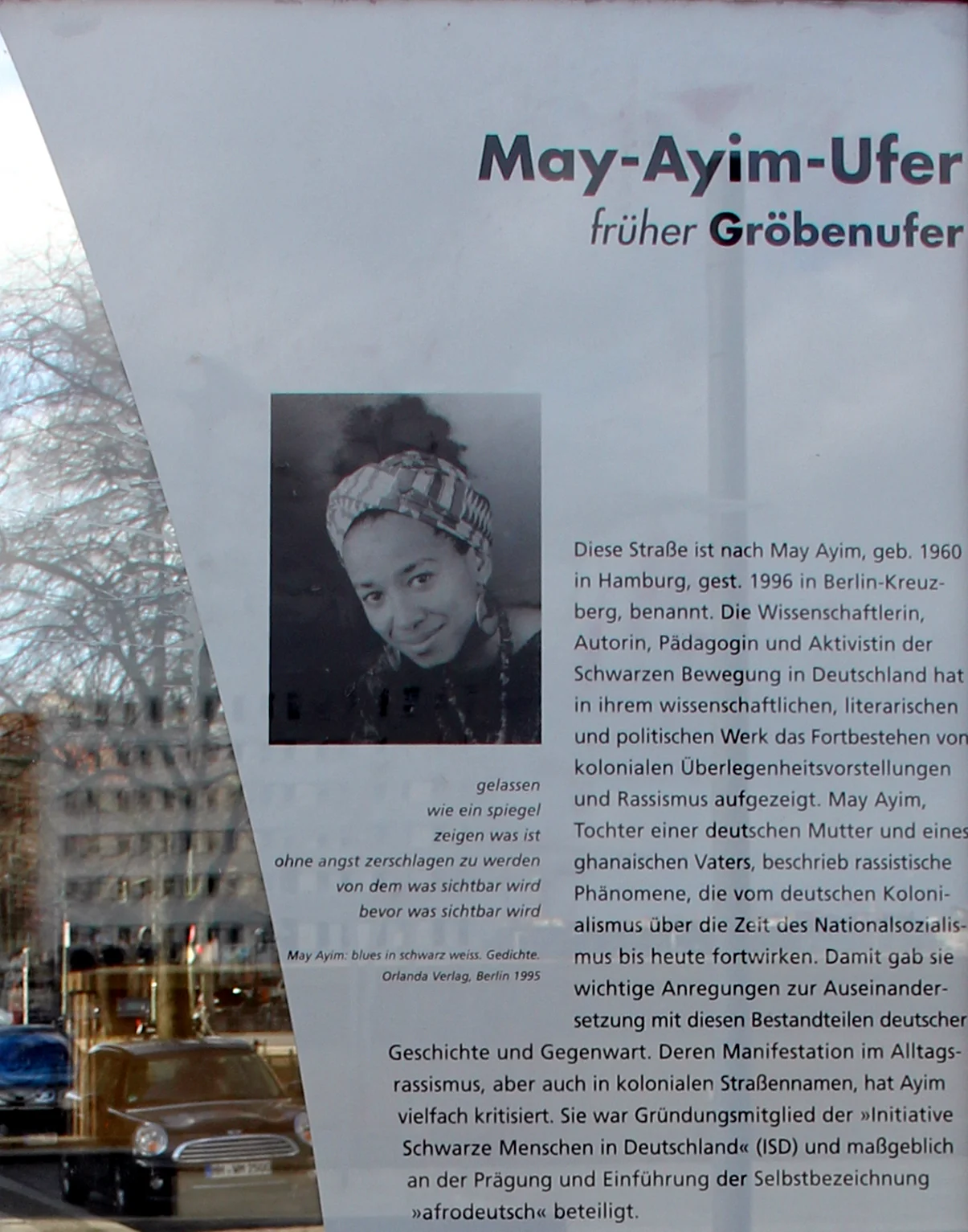
Image from Wikipedia
Image from Wikipedia
May Ayim: Voice, Resistance, and Poetic Radiance of a Pioneering Afro-German Author
An Exceptional Figure in German-Language Literature and Cultural History
May Ayim, born on May 3, 1960, in Hamburg and passed away on August 9, 1996, in Berlin, is considered one of the most significant voices of the Afro-German movement. As a poet, educator, scholar, librettist, and activist, she combined literary precision with political clarity. Under her legal name Sylvia Brigitte Gertrud Opitz, née Andler, she developed a body of work that merges personal experience, anti-racist analysis, and societal intervention with a rare intensity.
Her literary profile emerged from a consistent connection between biography and public life. May Ayim wrote not from a distance but from her own lived reality: from the experience of racism, marginalization, and self-empowerment. This is precisely where the enduring strength of her work lies, which remains present today in literature, educational work, and memory culture.
Biographical Roots and Early Influences
May Ayim grew up as the daughter of a Ghanaian father and a German mother, a background that significantly shaped her later perspective on belonging, language, and identity. The city of Hamburg marked her beginnings, while Berlin later became the site of her work and early death. This biographical span is reflected in her writing, which consistently intertwines personal experience with societal analysis.
From an early age, her work exhibited a strong awareness of educational processes, language, and representation. As an educator and scholar, she thought not just literarily but also structurally. Her view of Black German history and Afro-German realities opened new interpretations of the present and memory.
The Literary Development: Precision, Stance, and Counter-Speech
May Ayim’s literary language is clear, rhythmic, and marked by significant political sharpness. Her texts utilize condensation, repetition, and pointed observation without ever losing emotional depth. It is precisely this combination of poetic form and intellectual clarity that makes her texts so distinctive.
Her known works include Blues in schwarz weiss, Blues en noir et blanc : = Blues in schwarz weiss, Grenzenlos und unverschämt, and Weitergehen : Gedichte. Even the titles reflect the breadth of her work: poetic self-assertion, transgression of boundaries, and the will not to be confined linguistically or socially. In this sense, her literature is not only expression but also intervention.
A Milestone of the Afro-German Movement
A central role in May Ayim’s career was her commitment to the Afro-German movement and anti-racist practice in Germany. In 1985, she co-founded the Initiative Schwarze Deutsche and Schwarze in Deutschland, a historic step that created political visibility and strengthened collective self-organization. With this, she became a defining figure of a movement that redefined terms, narratives, and spaces.
Her involvement in Farbe bekennen. Afro-deutsche Frauen auf den Spuren ihrer Geschichte, which was published in 1986 together with Katharina Oguntoye and Dagmar Schultz, was also of particular significance. This work is considered a fundamental contribution to making Afro-German history visible and to female self-representation. Since then, May Ayim’s name has been inseparably linked to a shift in perspective that has sustainably changed German-speaking culture and memory politics.
Publications, Impact, and Editorial Presence
The documented publications and projects depict May Ayim as an author with analytical as well as aesthetic precision. Her texts range between poetry, essays, documentation, and collective knowledge production. This has resulted in a body of work that cannot be reduced to a single literary category but has an impact across multiple cultural fields.
The documentary reception of her life and work also reflects her influence. The film May Ayim. Hoffnung im Herz portrays her as an Afro-German poet and activist, highlighting her role in the history of Black German self-organization. The fact that the May Ayim Award, the first German Pan-African literary prize, was named after her underlines her continuing authority in literary and political memory.
Style and Artistic Signature
May Ayim's style unites lyrical density with social urgency. Her language is not ornamental but functional, without losing poetic power. She employs poetry as a form of insight, self-assertion, and counter-speech against racist attributions.
In her work, themes such as Black identity, feminist self-determination, memory, belonging, and resistance intertwine closely. This thematic density makes her texts key works of literature that not only describe but also make realities visible. It is from this that her cultural authority emerges beyond the literary scene.
Cultural Influence and Significance in Memory Politics
May Ayim's cultural influence extends far beyond her own work. She has helped anchor Afro-German history in public consciousness and has given the Black feminist perspective in Germany a literary voice. Today, her name stands for awakening, self-empowerment, and the ability to translate personal experience into societal language.
Her significance is also reflected in memory culture: since 2010, the former Gröbenufer on the Spree bears her name. Such namings are more than symbolic gestures, as they shift visibility in public spaces and the collective narrative. May Ayim's legacy thus remains alive, political, and highly relevant.
Current Relevance and Continuing Presence
Even decades after her death, May Ayim remains a central reference for literature, educational work, and anti-racist debates. Her texts continue to be read, quoted, and addressed in exhibitions, archives, and research contexts. The Digitale Deutsche Frauenarchiv and the Deutsche Digitale Bibliothek document her work and influence as part of German women's and movement history.
Especially in a present that is renegotiating questions of belonging, memory, and diversity, her voice continues to resonate powerfully. May Ayim represents literature with a stance, a biography that writes history, and a cultural presence that does not fade. Anyone who encounters her work meets an author of exceptional clarity and lasting relevance.
Conclusion: Why May Ayim Fascinates to This Day
May Ayim is compelling because she has condensed literature, activism, and cultural self-assertion into a unique voice. Her texts possess poetic power, political precision, and an emotional truthfulness that continues to resonate today. Anyone who wants to understand how literature can change societal reality cannot overlook her.
Encountering her work is always worthwhile, whether in reading, listening to her poems, or reflecting on their impact. May Ayim's legacy shows how powerful language can be when it emerges from experience, analysis, and artistic consequence. Her presence remains a mandate, and her texts echo far beyond her time.
Official Channels of May Ayim:
- Instagram: no official profile found
- Facebook: no official profile found
- YouTube: no official profile found
- Spotify: no official profile found
- TikTok: no official profile found