
Lovis Corinth
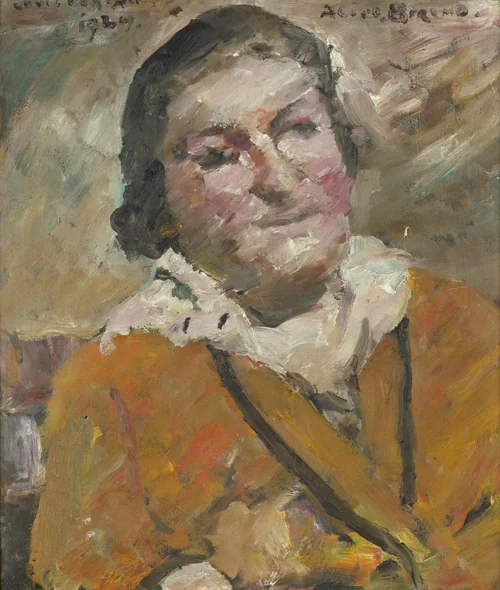
Image from Wikipedia
Image from Wikipedia
Lovis Corinth – Master Between Impressionism and Expressionism
An Artistic Life Full of Energy, Change, and Pioneering Images
Lovis Corinth, born in 1858 in Tapiau (East Prussia) and passed away in 1925 in Zandvoort, Netherlands, is considered one of the most influential German painters and graphic artists of modernity. His work has nothing to do with a music career – and yet, his artistic development resembles a symphonic dramaturgy: from realistic beginnings through impressionistic color tones to expressionistic fortissimos in his later phase. His oeuvre includes paintings, drawings, and a rich graphic portfolio; his name stands alongside Max Liebermann and Max Slevogt for the Berlin Secession and German Impressionism. His stage was the canvas, his stage presence the force of the brush, and his breakthrough the sovereign synthesis of observation, color, rhythm, and inner drama.
Education and Artistic Development: From Königsberg to Paris
Corinth's artistic career began in 1876 at the Academy in Königsberg, leading him to Munich from 1880, and to study stays in Antwerp and Paris in 1884. The academic rigor of Königsberg, the figurative observation in Munich, and the drawing discipline at the Académie Julian sharpened his expertise in composition, anatomy, and tonal values. He early admired the baroque vitality of Rubens without remaining stuck in historical painting. From Munich, he brought a realistic foundation, while in Paris he refined his drawing; the result is an artist who connects physicality and light control with rare conviction.
After returning in 1887 to the German art scene, Corinth reacted to the academic establishment with a modern, sensual visual language. In Berlin, starting in 1901, he found his artistic home: a pulsating metropolis whose exhibition landscape and gallery scene offered space for experiments. The Berlin Secession became his platform – and later his area of responsibility.
Berlin, Secession, Responsibility: Authority in the Art Field
The Berlin Secession represented artistic independence against state academies around 1900. Corinth joined the circle around Max Liebermann, becoming a defining face of the association and taking on leadership responsibilities in the 1910s. This phase documents his authority in the field: he co-curated, positioned, and fought for visual ideas that extended the spectrum from impressionist plein air painting to dramatic historical and religious subjects. His role as president (1915–1925) coincided with a time of profound aesthetic debate, during which he initially maintained distance from expressionism but later – due to internal and external upheavals – affirmatively integrated its expressive means.
The Turning Point of 1911: Illness as a Catalyst for Style
In December 1911, Corinth suffered a stroke that temporarily paralyzed him. This biographical break became an aesthetic turning point: his brushstroke became more vigorous, the palette more vibrant, and the structure of his images more dynamic. Where naturalistic calm once dominated, compositions emerged with heightened rhythmic density and expressive color drama. In this phase, landscapes, still lifes, portraits, and religious representations of extraordinary vitality were created – works in which experience and expertise become directly visible on the surface.
Motifs and Works: Portrait, Myth, Religion, Landscape
Corinth's discography of images – his thematic groups – can be read along four axes. First, portrait art: numerous self-portraits and portraits of his wife Charlotte Berend, who was closely linked to him as muse, model, painter, and later as a cataloguer of his works. Secondly, the mythological and literary subjects, in which he combined baroque abundance, studies of bodies and materials with dramatic light direction. Thirdly, the religious representations, where pathos, color intensity, and psychological focus produce a modern passion iconography. Fourthly, the landscapes – especially the Walchensee paintings – as lyrical yet energetically charged studies of water, wind, and light. These four strands intertwine into a complete work that oscillates between sensation and construction, observation and imagination.
Charlotte Berend-Corinth: Partner, Protagonist, Chronicler
The artistic relationship with Charlotte Berend is among the most productive artist partnerships of the time. As the first student in Corinth's painting school for women, she quickly became a model, wife, and independent painter. In iconic images, Corinth stages Charlotte in roles, costumes, and intimacies: a narrative about femininity, role-playing, and the closeness of two artistic temperaments. After Corinth's death, she organized his works, demonstrated authority in authentication matters, and laid the foundation for modern Corinth research with her catalog. Her work substantiates the reliability of the artworks' data, and her biographical records deepen the interpretation of individual image cycles.
Walchensee: Topography as a Soul Space
From 1919 onwards, the couple spent a lot of time at Walchensee. The paintings created there are not topographical postcards but painterly weather reports of the inner self: rolling wave crests, tipping horizons, dramatic skies. In terms of painting technique, Corinth condenses the impulses of the late Impressionists with an expressionist gesture. This series became a trademark of his late work and is now one of the most popular groups of works in collections and exhibitions – a lesson on the perception of nature, brush rhythm, and color harmony.
Graphic Art and Atelier Practice: Technique, Series, Variation
In addition to painting, Corinth developed a significant graphic production: etchings and lithographs, serial sequences on biblical themes, and thematic suites. The graphic art demonstrates his compositional inventiveness in economical strokes, the ability to condense volume, gesture, and affect with minimal means. Workshop logic and publication practice made these sheets important carriers of his visual ideas – mobile, circulable, and accessible to collectors. For art historical research, they are also seismographs of his stylistic processes.
Late Work: Color, Pain, Self-Reflection
In his last years, Corinth's painting condenses into a mature handwriting: color areas vibrate, contours dissolve, and the paint layer pulses. Religious themes reach an intensity where the historical iconography appears as a present experience. The late self-portraits – intimate, unvarnished, ruthless – link self-examination and painterly virtuosity. The final year of 1925 brings a series of paintings that mark both a conclusion and a new beginning; just a few weeks later, the life of this tireless worker with color comes to an end.
Reception, Exhibitions, Provenance: Authority in the Museum
Corinth's significance was evident early on in large exhibitions and monographic catalogs. His works are now part of the core collection of many institutions, including the collections of the Nationalgalerie in Berlin, where acquisitions, confiscations, and restitutions reflect the tumultuous institutional history of the 20th century. Research increasingly focuses not only on style and motif questions but also on provenance: gaps from 1933 to 1945, restitutions to heirs of Jewish collectors, reconstructions of collection paths. This work reinforces the reliability of the field and contextualizes the biographies of the works.
“Degenerate Art” and Its Consequences: Cultural Politics as a Caesura
After 1933, the Nazi regime denounced modern art as “degenerate” and confiscated thousands of works. Corinth's works also fell victim to this cleansing; some were displayed in the notorious exhibition, while others were sold abroad or destroyed. The attack on modernity obliterated contexts, severed the biographies of works, and blocked reception for decades. It was only posthumously – through research, restitution, and museum work – that the artistic achievement became visible again in its full range. This historical experience is part of the current authority of the canon: what endures asserts itself despite ideological upheavals.
Selected Works and Their Art Historical Contextualization
Corinth's portraits are laboratories of psychology: they combine precise physiognomy with painterly freedom – a tension that distinguishes him from purely optical Impressionists. In his religious paintings, he shifts the iconography from the sublime to the immediate; in the Walchensee landscapes, he relies on the energy of color, the reflected structure of the brush stroke, and the choreographed light. All this makes him a hinge artist between the epochs: a master of transitions whose composition and production unite technical expertise and existential experience.
Current Research and New Contexts
Exhibitions recognizing anniversaries and collection research bridge the gap between work and the present. Sketchbooks, letters, and prints offer insights into studio practice; provenance projects make ownership paths transparent. Museums not only create visibility but also review their own history – a dual movement that anchors Corinth's work in the public sphere and underscores its relevance for the art history of the 19th and 20th centuries.
Conclusion: Why Lovis Corinth Resonates Today
Corinth's art thrives on the tension between control and freedom, knowledge and risk. His artistic development from realistic observer to expressive creator shows how experience births style and how expertise is manifested in color and form. Those who view his images experience painting as an event: vibrating surfaces, dense atmospheres, psychologically charged figures. This makes Lovis Corinth an artist whose work still strikes a contemporary chord a hundred years after his death. Recommendation: Stand in front of a Walchensee painting in the museum, follow the brush rhythms – and experience the artist live in the original.
Official Channels of Lovis Corinth:
- Instagram: No official profile found
- Facebook: No official profile found
- YouTube: No official profile found
- Spotify: No official profile found
- TikTok: No official profile found
Sources:
- Wikipedia – Lovis Corinth
- Encyclopaedia Britannica – Lovis Corinth
- State Museums of Berlin – Nationalgalerie: In Sight! (Collection Notes and NS Context)
- Walchensee Museum – Lovis Corinth (Walchensee Works and Graphics)
- Kunstforum East German Gallery – “Lovis Corinth – Image Frenzy” (Exhibition Notice)
- Free University Berlin – Database “Degenerate Art” (Confiscations, Legal Foundations)
- German Digital Library – Lovis Corinth (Life Data, Work References)
- Jewish Museum Berlin – Corinth's Portrait of Charlotte Berend (Context and Interpretation)
- Wikipedia: Image and Text Source
Upcoming Events
Lovis Corinth – Image Rapture. Exhibition
Lovis Corinth - Picture Rapture. Lunch Break in the Museum. Short Tour
Thematic Tour: Lovis Corinth in Focus – From Sketch to Painting
Special Exhibition: HEAVENLY REUNION. From Ludwig I. to the Blue Rider
Special Exhibition: HEAVENLY REUNION. From Ludwig I. to the Blue Rider
Heavenly Reunion. From Ludwig I. to the Blue Rider
Special Exhibition: HEAVENLY REUNION. From Ludwig I. to the Blue Rider
Heavenly Reunion at the Diocesan Museum Freising
Heavenly Reunion at the Diocesan Museum Freising