
Passau
Danziger Str. 40, 94036 Passau, Deutschland
Dreiflüssestadion | Parking & Capacity
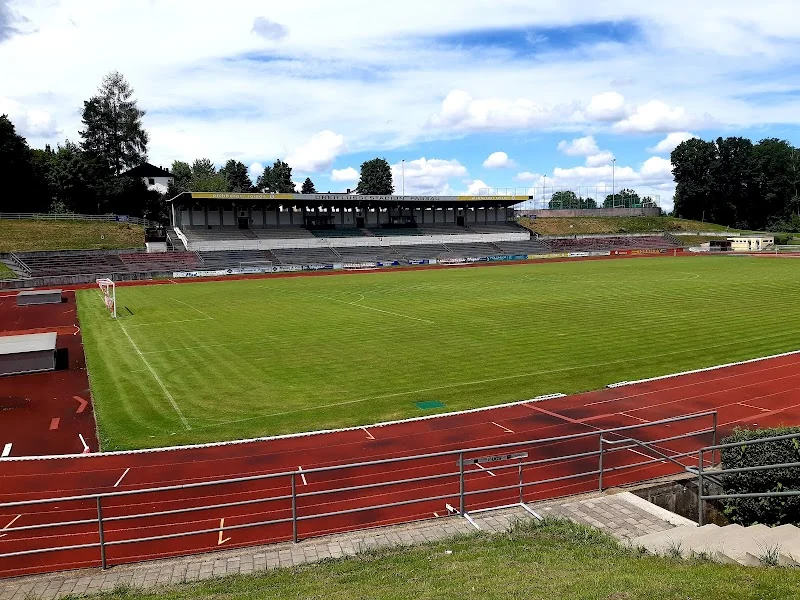
The Dreiflüssestadion in Passau is a traditional sports venue with modern usage in everyday life: Here, history, proximity to nature, and functional infrastructure come together. On the natural grass field with an adjacent athletics track, 1. FC Passau plays its home games, schools and clubs train regularly, and visitors to the Three Rivers City find a sporting focal point away from the old town. The facility was opened in 1969; it made history in 1972 as the venue for the Olympic football tournament. After a structural reduction in 2015/16, the stadium now accommodates 6,000 spectators, including about 1,100 covered seats in the main grandstand. In 2024, the track received a new, water-permeable synthetic surface along with digital timing, significantly enhancing training and competitions. Thanks to precise navigation to Danziger Straße 40, Park & Ride options, and a solid bus connection, getting there is straightforward. First-time visitors to the stadium experience a wide view of the field and the characteristic bowl shape of the stands from the grandstand – a place where the sports history of Passau comes alive.
Parking at Dreiflüssestadion Passau
Around Danziger Straße, parking on game days is usually unproblematic, as long as you plan your time and follow the signage. There are marked parking spaces and street parking in the vicinity of the stadium; during larger crowds, the city's Park & Ride options are recommended. The city of Passau operates a dynamic parking guidance system that directs drivers to available capacities in parking garages and open spaces. For longer stays or during heavy traffic, P+R Kapuzinerstraße is particularly suitable, from where buses run frequently towards the city center; P+R Ilzbrücke, which is open all day and has fixed daily and weekly rates, is also well suited. Those wishing to visit the old town before or after the game benefit from the Park & Go principle at Ilzbrücke, where the walk to the old town takes just a few minutes and bus connections are available. For travelers staying longer in Passau or embarking on a river cruise, privately operated, fenced parking areas with shuttle services exist; these are not stadium-bound but are conveniently located and partially flood-proof. Guests of the nearby hotel location on Danziger Straße can, depending on availability, use on-site parking spaces or an underground garage; however, for stadium visitors without a hotel booking, the guest principle applies there. Generally, it is advisable to arrive early for peak games to find a parking space near the stadium or to use Park & Ride specifically and comfortably complete the last leg by bus. The address Danziger Straße 40 is suitable for navigation systems; on-site signs direct you to entrances and temporary closures. Those traveling in a motorhome will find separate offers with daily rates in Passau; however, for the stadium visit, using regular parking spaces or Park & Ride is the most pragmatic solution. Tip: Check the city's current notices on parking spaces and temporary closures as well as public transport information on the event day.
Capacity, Seats, and Stadium Structure
The Dreiflüssestadion was designed as a multifunctional football and athletics stadium. Today it offers 6,000 seats, after the facility was partially reduced in size for safety and maintenance reasons in 2015/16. The centerpiece is the covered main grandstand with about 1,100 seats. From here, one looks out onto a standard-sized natural grass field of approximately 104 × 67 meters, surrounded by a synthetic track. The rest of the spectator capacity is traditionally distributed among standing places, allowing for an unobstructed view of the field in wide radii. Historically, the capacity was around 20,000 seats; this explains why image archives still show massive grandstand structures and densely filled curves. In practice, the current structure means: those seeking a weatherproof, clear perspective should choose central rows on the main grandstand. For fans wanting to be close to the action, the lower standing areas along the sidelines are ideal, where duels and ball sequences can be experienced up close. There is no graphical seating plan like in multi-story arenas; seating choice is oriented around these functional zones. Families benefit from the quieter middle blocks of the grandstand, while lively fan areas are traditionally found in sections close to standing areas. The stadium is designed as a municipal sports facility, which is why the infrastructure is compact and manageable; the paths from the entrances to the stands are short, and orientation is easy. Additional training areas – a side pitch and a separate artificial turf field in the vicinity – relieve the match operations, so that the natural grass in the stadium can remain in good condition even with high occupancy. The track, in turn, is divided into six 400-meter lanes and additional short-distance lanes, which is particularly relevant for school sports and club athletics. The new, water-permeable surface reduces puddle formation, the surface dries faster, and usability increases in changeable weather. Thus, the Dreiflüssestadion is equally practical for league games, test matches, and athletics events.
Images and Photos of Dreiflüssestadion
If you want to get a sense of the venue's flair in advance, you will find extensive, dated photo series online showing exterior views, stands, the field, and details of the grandstand. Typical are panoramic shots from the main grandstand towards the opposite curves, which make the expanse of the oval visible. Also frequently documented: the track with contrasting colored surface and the arrangement of standing and seating areas. For photographers, switching between elevated and ground-level positions is worthwhile on-site. From above, tactical formations and the symmetry of the track lines can be captured; with telephoto lenses, dynamic close-ups of the game along the sidelines can be created. In daylight, the early evening hour is recommended when the soft light models the grandstand structure and the grass appears lush. After rainfalls, reflections on the track create interesting accents. Please observe the usual regulations during games: professional equipment with large telephoto lenses or tripod-like supports is generally not permitted in spectator areas; the house rules and the house rights of the organizer are decisive. Away from game days, many pictures show the clear lines and the classic stadium profile without massive structures – a reason why the facility is appreciated in stadium portals as a time document of Bavarian football architecture of the post-war period. Comparison photos showing the condition before and after the reduction of the 2010s and contrasting the current version with 6,000 seats to the earlier 20,000-seat era are also popular. For history enthusiasts, a look at photo series from 1972, when the stadium hosted Olympic group matches, is worthwhile; here, iconic motifs with high occupancy appear. And those looking for more recent impressions can find game scenes of 1. FC Passau in club channels – from the team lineup to goal celebrations – showcasing the stadium in its current matchday look.
History and Highlights from 1969 to Today
The roots of the Dreiflüssestadion date back to the late 1960s. Already in 1968, the facility was the venue for the Lower Bavarian Youth Games, and it was officially opened in 1969. Thus, a modern football and athletics stadium was ready in Passau, which soon received international attention: in 1972, Passau was one of six venues for the Olympic football tournament in Munich. A total of six matches were held here, including preliminary and quarter-final matches. The capacity at that time was around 20,000 seats; the impressive backdrop is traceable in reports and image documents, with the spectator record being reported at around 19,000 visitors during the tournament. In the years following the Olympics, the stadium remained a focal point for special events. In 1991, the final of the Fuji Cup between Borussia Dortmund and Werder Bremen took place in Passau – another prominent entry in the stadium chronicle. Benefit and test matches also attracted attention, such as a highly publicized match of FC Bayern Munich in the early 2000s for local aid projects. The 2010s brought a structural change: in 2015, the dilapidated north stand was demolished, and in 2016, further capacity adjustments were made. Since then, the current maximum number of 6,000 seats has been significant, with the core grandstand featuring about 1,100 covered seats. At the same time, the facility remained important as a training and competition venue for athletics. A milestone in recent times is the renovation of the track completed in 2024: the old surface was removed, unevenness was leveled, drainage elements were renewed, and a modern, water-permeable synthetic surface was installed. Additionally, the facility received a digital timing diagnostic system, which benefits not only club sports but also school operations and enables official timing after certification. The history of the Dreiflüssestadion is thus a story of adaptation: from the large tournament arena of the 1970s and 1990s to the compact, economically viable sports facility of the present, which has retained its character.
Access, Bus, and Public Transport in the Three Rivers City
The address Danziger Straße 40 is the central orientation for navigation and route planning. Those arriving by car can reach Passau via the A3 motorway; depending on the direction, the exits lead into the city and further along Neuburger Straße before turning onto Danziger Straße. On-site signs facilitate orientation to the sports facilities. For the last mile, two bus stops are particularly suitable: Danziger Straße and Schönleitnerweg. These are served by several lines depending on the time of day and schedule, connecting the stadium area closely with the central bus station and the city center. Relevant lines include 1 and 2 (ZOB connection) as well as 5, 6, 7, 8, and 9. Those coming from outside can use Park & Ride, parking their vehicle, for example, at Kapuzinerstraße or Ilzbrücke, and continue by bus. The Passau city services publish schedules and offer digital information on connection inquiries and apps, so that current timings and any adjustments – for example, during major events or construction periods – are transparent. Train travelers disembark at the main train station and switch directly in front of the building to the city bus towards ZOB to transfer to the lines towards Danziger Straße or Schönleitnerweg. Thanks to short distances, the bus ride from the center to the stadium area takes only a few minutes. For cyclists, it is advisable to check the topography of the route, as there are slight inclines towards the stadium in the south of Passau. Taxis and ride services are available at the train station; depending on traffic, it takes about ten minutes to Danziger Straße. Important for planning: The city of Passau informs online about temporary closures, construction sites, and possible detours. Those choosing intelligent combinations – P+R plus bus – avoid searching for parking, reduce traffic in the old town, and gain valuable time before kick-off.
Current Use: 1. FC Passau, School and Club Sports
The Dreiflüssestadion is the home ground of 1. FC Passau and is regularly the venue for league games, test matches, and youth matches. The compact capacity creates an approachable football experience: short distances between the field and spectators promote an intense atmosphere without compromising the clear structure of the facility. Beyond football usage, the stadium serves as a municipal sports facility in continuous use. Schools utilize the track and segments for sprints, jumps, and throws; clubs from the region – including athletics communities – benefit from the six 400-meter lanes, the eight short-distance lanes, and the areas for high jump and triple jump. The recent renovation significantly enhances the quality of training conditions; the water-permeable surface reduces downtime after rain, and the digital timing system supports lessons, federal youth games, and official competitions. Seasonal highlights include preparation matches of higher-class teams, regional championships in youth sports, or friendly encounters where the grass proves its suitability for the stadium. The combination of natural grass and an adjacent track makes the facility suitable for versatile sports days and club celebrations. At the same time, the clear orientation as a sports venue prevents the area from being burdened by heavy stage materials, as is common in large concert productions; thus, the grass quality for league operations is maintained. For organizers of smaller sports events, the structure offers advantages: short setup and teardown paths, clear escape routes, known access points. Visitors appreciate the clarity, the easy finding of seats, and the short distance to public transport stops. In summary, the Dreiflüssestadion is a robust, practical sports arena with historical roots that strengthens the sporting foundation of the Three Rivers City.
Sources:
Mehr anzeigenWeniger anzeigen
Dreiflüssestadion | Parking & Capacity
The Dreiflüssestadion in Passau is a traditional sports venue with modern usage in everyday life: Here, history, proximity to nature, and functional infrastructure come together. On the natural grass field with an adjacent athletics track, 1. FC Passau plays its home games, schools and clubs train regularly, and visitors to the Three Rivers City find a sporting focal point away from the old town. The facility was opened in 1969; it made history in 1972 as the venue for the Olympic football tournament. After a structural reduction in 2015/16, the stadium now accommodates 6,000 spectators, including about 1,100 covered seats in the main grandstand. In 2024, the track received a new, water-permeable synthetic surface along with digital timing, significantly enhancing training and competitions. Thanks to precise navigation to Danziger Straße 40, Park & Ride options, and a solid bus connection, getting there is straightforward. First-time visitors to the stadium experience a wide view of the field and the characteristic bowl shape of the stands from the grandstand – a place where the sports history of Passau comes alive.
Parking at Dreiflüssestadion Passau
Around Danziger Straße, parking on game days is usually unproblematic, as long as you plan your time and follow the signage. There are marked parking spaces and street parking in the vicinity of the stadium; during larger crowds, the city's Park & Ride options are recommended. The city of Passau operates a dynamic parking guidance system that directs drivers to available capacities in parking garages and open spaces. For longer stays or during heavy traffic, P+R Kapuzinerstraße is particularly suitable, from where buses run frequently towards the city center; P+R Ilzbrücke, which is open all day and has fixed daily and weekly rates, is also well suited. Those wishing to visit the old town before or after the game benefit from the Park & Go principle at Ilzbrücke, where the walk to the old town takes just a few minutes and bus connections are available. For travelers staying longer in Passau or embarking on a river cruise, privately operated, fenced parking areas with shuttle services exist; these are not stadium-bound but are conveniently located and partially flood-proof. Guests of the nearby hotel location on Danziger Straße can, depending on availability, use on-site parking spaces or an underground garage; however, for stadium visitors without a hotel booking, the guest principle applies there. Generally, it is advisable to arrive early for peak games to find a parking space near the stadium or to use Park & Ride specifically and comfortably complete the last leg by bus. The address Danziger Straße 40 is suitable for navigation systems; on-site signs direct you to entrances and temporary closures. Those traveling in a motorhome will find separate offers with daily rates in Passau; however, for the stadium visit, using regular parking spaces or Park & Ride is the most pragmatic solution. Tip: Check the city's current notices on parking spaces and temporary closures as well as public transport information on the event day.
Capacity, Seats, and Stadium Structure
The Dreiflüssestadion was designed as a multifunctional football and athletics stadium. Today it offers 6,000 seats, after the facility was partially reduced in size for safety and maintenance reasons in 2015/16. The centerpiece is the covered main grandstand with about 1,100 seats. From here, one looks out onto a standard-sized natural grass field of approximately 104 × 67 meters, surrounded by a synthetic track. The rest of the spectator capacity is traditionally distributed among standing places, allowing for an unobstructed view of the field in wide radii. Historically, the capacity was around 20,000 seats; this explains why image archives still show massive grandstand structures and densely filled curves. In practice, the current structure means: those seeking a weatherproof, clear perspective should choose central rows on the main grandstand. For fans wanting to be close to the action, the lower standing areas along the sidelines are ideal, where duels and ball sequences can be experienced up close. There is no graphical seating plan like in multi-story arenas; seating choice is oriented around these functional zones. Families benefit from the quieter middle blocks of the grandstand, while lively fan areas are traditionally found in sections close to standing areas. The stadium is designed as a municipal sports facility, which is why the infrastructure is compact and manageable; the paths from the entrances to the stands are short, and orientation is easy. Additional training areas – a side pitch and a separate artificial turf field in the vicinity – relieve the match operations, so that the natural grass in the stadium can remain in good condition even with high occupancy. The track, in turn, is divided into six 400-meter lanes and additional short-distance lanes, which is particularly relevant for school sports and club athletics. The new, water-permeable surface reduces puddle formation, the surface dries faster, and usability increases in changeable weather. Thus, the Dreiflüssestadion is equally practical for league games, test matches, and athletics events.
Images and Photos of Dreiflüssestadion
If you want to get a sense of the venue's flair in advance, you will find extensive, dated photo series online showing exterior views, stands, the field, and details of the grandstand. Typical are panoramic shots from the main grandstand towards the opposite curves, which make the expanse of the oval visible. Also frequently documented: the track with contrasting colored surface and the arrangement of standing and seating areas. For photographers, switching between elevated and ground-level positions is worthwhile on-site. From above, tactical formations and the symmetry of the track lines can be captured; with telephoto lenses, dynamic close-ups of the game along the sidelines can be created. In daylight, the early evening hour is recommended when the soft light models the grandstand structure and the grass appears lush. After rainfalls, reflections on the track create interesting accents. Please observe the usual regulations during games: professional equipment with large telephoto lenses or tripod-like supports is generally not permitted in spectator areas; the house rules and the house rights of the organizer are decisive. Away from game days, many pictures show the clear lines and the classic stadium profile without massive structures – a reason why the facility is appreciated in stadium portals as a time document of Bavarian football architecture of the post-war period. Comparison photos showing the condition before and after the reduction of the 2010s and contrasting the current version with 6,000 seats to the earlier 20,000-seat era are also popular. For history enthusiasts, a look at photo series from 1972, when the stadium hosted Olympic group matches, is worthwhile; here, iconic motifs with high occupancy appear. And those looking for more recent impressions can find game scenes of 1. FC Passau in club channels – from the team lineup to goal celebrations – showcasing the stadium in its current matchday look.
History and Highlights from 1969 to Today
The roots of the Dreiflüssestadion date back to the late 1960s. Already in 1968, the facility was the venue for the Lower Bavarian Youth Games, and it was officially opened in 1969. Thus, a modern football and athletics stadium was ready in Passau, which soon received international attention: in 1972, Passau was one of six venues for the Olympic football tournament in Munich. A total of six matches were held here, including preliminary and quarter-final matches. The capacity at that time was around 20,000 seats; the impressive backdrop is traceable in reports and image documents, with the spectator record being reported at around 19,000 visitors during the tournament. In the years following the Olympics, the stadium remained a focal point for special events. In 1991, the final of the Fuji Cup between Borussia Dortmund and Werder Bremen took place in Passau – another prominent entry in the stadium chronicle. Benefit and test matches also attracted attention, such as a highly publicized match of FC Bayern Munich in the early 2000s for local aid projects. The 2010s brought a structural change: in 2015, the dilapidated north stand was demolished, and in 2016, further capacity adjustments were made. Since then, the current maximum number of 6,000 seats has been significant, with the core grandstand featuring about 1,100 covered seats. At the same time, the facility remained important as a training and competition venue for athletics. A milestone in recent times is the renovation of the track completed in 2024: the old surface was removed, unevenness was leveled, drainage elements were renewed, and a modern, water-permeable synthetic surface was installed. Additionally, the facility received a digital timing diagnostic system, which benefits not only club sports but also school operations and enables official timing after certification. The history of the Dreiflüssestadion is thus a story of adaptation: from the large tournament arena of the 1970s and 1990s to the compact, economically viable sports facility of the present, which has retained its character.
Access, Bus, and Public Transport in the Three Rivers City
The address Danziger Straße 40 is the central orientation for navigation and route planning. Those arriving by car can reach Passau via the A3 motorway; depending on the direction, the exits lead into the city and further along Neuburger Straße before turning onto Danziger Straße. On-site signs facilitate orientation to the sports facilities. For the last mile, two bus stops are particularly suitable: Danziger Straße and Schönleitnerweg. These are served by several lines depending on the time of day and schedule, connecting the stadium area closely with the central bus station and the city center. Relevant lines include 1 and 2 (ZOB connection) as well as 5, 6, 7, 8, and 9. Those coming from outside can use Park & Ride, parking their vehicle, for example, at Kapuzinerstraße or Ilzbrücke, and continue by bus. The Passau city services publish schedules and offer digital information on connection inquiries and apps, so that current timings and any adjustments – for example, during major events or construction periods – are transparent. Train travelers disembark at the main train station and switch directly in front of the building to the city bus towards ZOB to transfer to the lines towards Danziger Straße or Schönleitnerweg. Thanks to short distances, the bus ride from the center to the stadium area takes only a few minutes. For cyclists, it is advisable to check the topography of the route, as there are slight inclines towards the stadium in the south of Passau. Taxis and ride services are available at the train station; depending on traffic, it takes about ten minutes to Danziger Straße. Important for planning: The city of Passau informs online about temporary closures, construction sites, and possible detours. Those choosing intelligent combinations – P+R plus bus – avoid searching for parking, reduce traffic in the old town, and gain valuable time before kick-off.
Current Use: 1. FC Passau, School and Club Sports
The Dreiflüssestadion is the home ground of 1. FC Passau and is regularly the venue for league games, test matches, and youth matches. The compact capacity creates an approachable football experience: short distances between the field and spectators promote an intense atmosphere without compromising the clear structure of the facility. Beyond football usage, the stadium serves as a municipal sports facility in continuous use. Schools utilize the track and segments for sprints, jumps, and throws; clubs from the region – including athletics communities – benefit from the six 400-meter lanes, the eight short-distance lanes, and the areas for high jump and triple jump. The recent renovation significantly enhances the quality of training conditions; the water-permeable surface reduces downtime after rain, and the digital timing system supports lessons, federal youth games, and official competitions. Seasonal highlights include preparation matches of higher-class teams, regional championships in youth sports, or friendly encounters where the grass proves its suitability for the stadium. The combination of natural grass and an adjacent track makes the facility suitable for versatile sports days and club celebrations. At the same time, the clear orientation as a sports venue prevents the area from being burdened by heavy stage materials, as is common in large concert productions; thus, the grass quality for league operations is maintained. For organizers of smaller sports events, the structure offers advantages: short setup and teardown paths, clear escape routes, known access points. Visitors appreciate the clarity, the easy finding of seats, and the short distance to public transport stops. In summary, the Dreiflüssestadion is a robust, practical sports arena with historical roots that strengthens the sporting foundation of the Three Rivers City.
Sources:
Dreiflüssestadion | Parking & Capacity
The Dreiflüssestadion in Passau is a traditional sports venue with modern usage in everyday life: Here, history, proximity to nature, and functional infrastructure come together. On the natural grass field with an adjacent athletics track, 1. FC Passau plays its home games, schools and clubs train regularly, and visitors to the Three Rivers City find a sporting focal point away from the old town. The facility was opened in 1969; it made history in 1972 as the venue for the Olympic football tournament. After a structural reduction in 2015/16, the stadium now accommodates 6,000 spectators, including about 1,100 covered seats in the main grandstand. In 2024, the track received a new, water-permeable synthetic surface along with digital timing, significantly enhancing training and competitions. Thanks to precise navigation to Danziger Straße 40, Park & Ride options, and a solid bus connection, getting there is straightforward. First-time visitors to the stadium experience a wide view of the field and the characteristic bowl shape of the stands from the grandstand – a place where the sports history of Passau comes alive.
Parking at Dreiflüssestadion Passau
Around Danziger Straße, parking on game days is usually unproblematic, as long as you plan your time and follow the signage. There are marked parking spaces and street parking in the vicinity of the stadium; during larger crowds, the city's Park & Ride options are recommended. The city of Passau operates a dynamic parking guidance system that directs drivers to available capacities in parking garages and open spaces. For longer stays or during heavy traffic, P+R Kapuzinerstraße is particularly suitable, from where buses run frequently towards the city center; P+R Ilzbrücke, which is open all day and has fixed daily and weekly rates, is also well suited. Those wishing to visit the old town before or after the game benefit from the Park & Go principle at Ilzbrücke, where the walk to the old town takes just a few minutes and bus connections are available. For travelers staying longer in Passau or embarking on a river cruise, privately operated, fenced parking areas with shuttle services exist; these are not stadium-bound but are conveniently located and partially flood-proof. Guests of the nearby hotel location on Danziger Straße can, depending on availability, use on-site parking spaces or an underground garage; however, for stadium visitors without a hotel booking, the guest principle applies there. Generally, it is advisable to arrive early for peak games to find a parking space near the stadium or to use Park & Ride specifically and comfortably complete the last leg by bus. The address Danziger Straße 40 is suitable for navigation systems; on-site signs direct you to entrances and temporary closures. Those traveling in a motorhome will find separate offers with daily rates in Passau; however, for the stadium visit, using regular parking spaces or Park & Ride is the most pragmatic solution. Tip: Check the city's current notices on parking spaces and temporary closures as well as public transport information on the event day.
Capacity, Seats, and Stadium Structure
The Dreiflüssestadion was designed as a multifunctional football and athletics stadium. Today it offers 6,000 seats, after the facility was partially reduced in size for safety and maintenance reasons in 2015/16. The centerpiece is the covered main grandstand with about 1,100 seats. From here, one looks out onto a standard-sized natural grass field of approximately 104 × 67 meters, surrounded by a synthetic track. The rest of the spectator capacity is traditionally distributed among standing places, allowing for an unobstructed view of the field in wide radii. Historically, the capacity was around 20,000 seats; this explains why image archives still show massive grandstand structures and densely filled curves. In practice, the current structure means: those seeking a weatherproof, clear perspective should choose central rows on the main grandstand. For fans wanting to be close to the action, the lower standing areas along the sidelines are ideal, where duels and ball sequences can be experienced up close. There is no graphical seating plan like in multi-story arenas; seating choice is oriented around these functional zones. Families benefit from the quieter middle blocks of the grandstand, while lively fan areas are traditionally found in sections close to standing areas. The stadium is designed as a municipal sports facility, which is why the infrastructure is compact and manageable; the paths from the entrances to the stands are short, and orientation is easy. Additional training areas – a side pitch and a separate artificial turf field in the vicinity – relieve the match operations, so that the natural grass in the stadium can remain in good condition even with high occupancy. The track, in turn, is divided into six 400-meter lanes and additional short-distance lanes, which is particularly relevant for school sports and club athletics. The new, water-permeable surface reduces puddle formation, the surface dries faster, and usability increases in changeable weather. Thus, the Dreiflüssestadion is equally practical for league games, test matches, and athletics events.
Images and Photos of Dreiflüssestadion
If you want to get a sense of the venue's flair in advance, you will find extensive, dated photo series online showing exterior views, stands, the field, and details of the grandstand. Typical are panoramic shots from the main grandstand towards the opposite curves, which make the expanse of the oval visible. Also frequently documented: the track with contrasting colored surface and the arrangement of standing and seating areas. For photographers, switching between elevated and ground-level positions is worthwhile on-site. From above, tactical formations and the symmetry of the track lines can be captured; with telephoto lenses, dynamic close-ups of the game along the sidelines can be created. In daylight, the early evening hour is recommended when the soft light models the grandstand structure and the grass appears lush. After rainfalls, reflections on the track create interesting accents. Please observe the usual regulations during games: professional equipment with large telephoto lenses or tripod-like supports is generally not permitted in spectator areas; the house rules and the house rights of the organizer are decisive. Away from game days, many pictures show the clear lines and the classic stadium profile without massive structures – a reason why the facility is appreciated in stadium portals as a time document of Bavarian football architecture of the post-war period. Comparison photos showing the condition before and after the reduction of the 2010s and contrasting the current version with 6,000 seats to the earlier 20,000-seat era are also popular. For history enthusiasts, a look at photo series from 1972, when the stadium hosted Olympic group matches, is worthwhile; here, iconic motifs with high occupancy appear. And those looking for more recent impressions can find game scenes of 1. FC Passau in club channels – from the team lineup to goal celebrations – showcasing the stadium in its current matchday look.
History and Highlights from 1969 to Today
The roots of the Dreiflüssestadion date back to the late 1960s. Already in 1968, the facility was the venue for the Lower Bavarian Youth Games, and it was officially opened in 1969. Thus, a modern football and athletics stadium was ready in Passau, which soon received international attention: in 1972, Passau was one of six venues for the Olympic football tournament in Munich. A total of six matches were held here, including preliminary and quarter-final matches. The capacity at that time was around 20,000 seats; the impressive backdrop is traceable in reports and image documents, with the spectator record being reported at around 19,000 visitors during the tournament. In the years following the Olympics, the stadium remained a focal point for special events. In 1991, the final of the Fuji Cup between Borussia Dortmund and Werder Bremen took place in Passau – another prominent entry in the stadium chronicle. Benefit and test matches also attracted attention, such as a highly publicized match of FC Bayern Munich in the early 2000s for local aid projects. The 2010s brought a structural change: in 2015, the dilapidated north stand was demolished, and in 2016, further capacity adjustments were made. Since then, the current maximum number of 6,000 seats has been significant, with the core grandstand featuring about 1,100 covered seats. At the same time, the facility remained important as a training and competition venue for athletics. A milestone in recent times is the renovation of the track completed in 2024: the old surface was removed, unevenness was leveled, drainage elements were renewed, and a modern, water-permeable synthetic surface was installed. Additionally, the facility received a digital timing diagnostic system, which benefits not only club sports but also school operations and enables official timing after certification. The history of the Dreiflüssestadion is thus a story of adaptation: from the large tournament arena of the 1970s and 1990s to the compact, economically viable sports facility of the present, which has retained its character.
Access, Bus, and Public Transport in the Three Rivers City
The address Danziger Straße 40 is the central orientation for navigation and route planning. Those arriving by car can reach Passau via the A3 motorway; depending on the direction, the exits lead into the city and further along Neuburger Straße before turning onto Danziger Straße. On-site signs facilitate orientation to the sports facilities. For the last mile, two bus stops are particularly suitable: Danziger Straße and Schönleitnerweg. These are served by several lines depending on the time of day and schedule, connecting the stadium area closely with the central bus station and the city center. Relevant lines include 1 and 2 (ZOB connection) as well as 5, 6, 7, 8, and 9. Those coming from outside can use Park & Ride, parking their vehicle, for example, at Kapuzinerstraße or Ilzbrücke, and continue by bus. The Passau city services publish schedules and offer digital information on connection inquiries and apps, so that current timings and any adjustments – for example, during major events or construction periods – are transparent. Train travelers disembark at the main train station and switch directly in front of the building to the city bus towards ZOB to transfer to the lines towards Danziger Straße or Schönleitnerweg. Thanks to short distances, the bus ride from the center to the stadium area takes only a few minutes. For cyclists, it is advisable to check the topography of the route, as there are slight inclines towards the stadium in the south of Passau. Taxis and ride services are available at the train station; depending on traffic, it takes about ten minutes to Danziger Straße. Important for planning: The city of Passau informs online about temporary closures, construction sites, and possible detours. Those choosing intelligent combinations – P+R plus bus – avoid searching for parking, reduce traffic in the old town, and gain valuable time before kick-off.
Current Use: 1. FC Passau, School and Club Sports
The Dreiflüssestadion is the home ground of 1. FC Passau and is regularly the venue for league games, test matches, and youth matches. The compact capacity creates an approachable football experience: short distances between the field and spectators promote an intense atmosphere without compromising the clear structure of the facility. Beyond football usage, the stadium serves as a municipal sports facility in continuous use. Schools utilize the track and segments for sprints, jumps, and throws; clubs from the region – including athletics communities – benefit from the six 400-meter lanes, the eight short-distance lanes, and the areas for high jump and triple jump. The recent renovation significantly enhances the quality of training conditions; the water-permeable surface reduces downtime after rain, and the digital timing system supports lessons, federal youth games, and official competitions. Seasonal highlights include preparation matches of higher-class teams, regional championships in youth sports, or friendly encounters where the grass proves its suitability for the stadium. The combination of natural grass and an adjacent track makes the facility suitable for versatile sports days and club celebrations. At the same time, the clear orientation as a sports venue prevents the area from being burdened by heavy stage materials, as is common in large concert productions; thus, the grass quality for league operations is maintained. For organizers of smaller sports events, the structure offers advantages: short setup and teardown paths, clear escape routes, known access points. Visitors appreciate the clarity, the easy finding of seats, and the short distance to public transport stops. In summary, the Dreiflüssestadion is a robust, practical sports arena with historical roots that strengthens the sporting foundation of the Three Rivers City.
Sources:
Upcoming Events
No events found
Frequently Asked Questions
Reviews
Steffen Jünge
13. October 2025
Very nice small stadium with a great Indian restaurant. The food was awesome.
Michael Richter
7. September 2025
Nice stadium.
RopycightSererved
4. August 2019
Great facility! It has a lot of charm!
Sebastian Graßl
14. October 2024
Beautiful old facility, unfortunately very few spectators. The matches of the regional league deserved more audience.
Adamantium
19. June 2024
Unfortunately, I can't recommend the club (youth management and some coaches). Once and never again!!!!!