
Simon Höfele
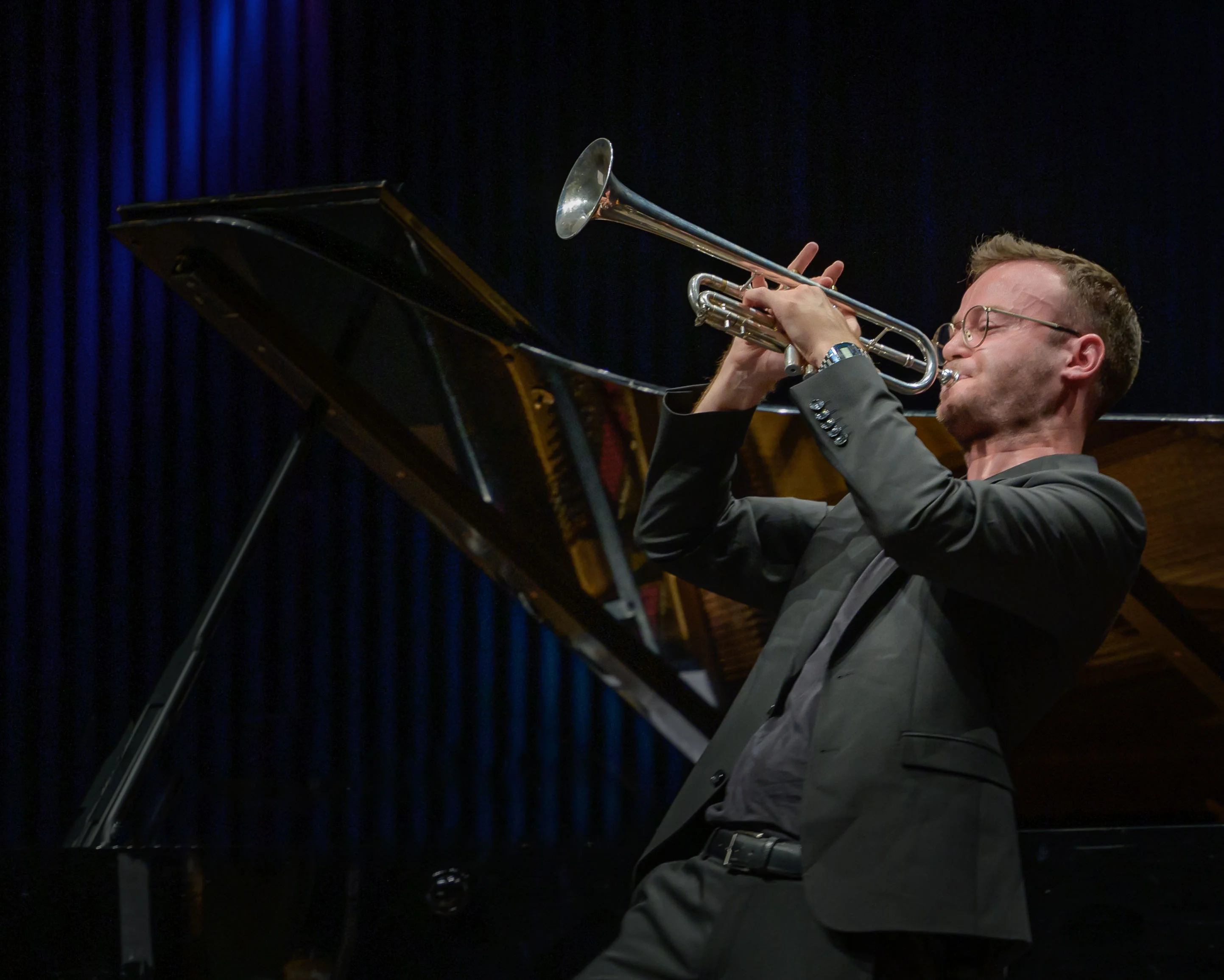
Image from Wikipedia
Image from Wikipedia
Simon Höfele
The Sound Creator of the Trumpet: How Simon Höfele Propels Classical Music into Today
Simon Höfele, born in 1994 in Darmstadt, is one of the most distinctive trumpeters of his generation. With a stage presence that combines virtuosic precision and narrative depth, he transcends stylistic boundaries between classical repertoire, contemporary music, and crossover projects. His musical career reflects a consistent artistic development: from an early-promoted talent to a sought-after soloist with top international orchestras, from an award-winner to a sound artist with his own fingerprint. In addition to the stage, he has a particular passion for coffee (barista) and photography—facets that make his art both visible and audible.
Biography: From Early Impulses to an International Career
Introduced to the trumpet at an early age, Höfele received formative impulses from renowned teaching traditions and quickly developed a distinct sound conception. Even at the beginning of his career, his smooth tone production, flexible articulation, and pronounced understanding of form and dramaturgy stood out. His artistic development continued consistently: performances with leading orchestras such as the Royal Concertgebouw Orchestra, the Mahler Chamber Orchestra, BBC orchestras, as well as significant ensembles in the German-speaking world cemented his name in the international scene. Collaborations with conductors like Semyon Bychkov, Joana Mallwitz, Markus Stenz, and Duncan Ward substantially shaped his repertoire and stylistic profile, always with a focus on composition, arrangement, and the history of genres.
Career Highlights: Residencies, Debuts, and Festival Presence
Recent milestones include residencies and debuts that document his artistic spectrum: as Artist in Residence, he demonstrated curatorial competence, program imagination, and the ability to lead ensembles without a conductor. Debuts with PhilZuid and the Tiroler Symphonieorchester Innsbruck, as well as return invitations to German and international orchestras, underline his established position. In venues like Wigmore Hall, Wiener Konzerthaus, Tonhalle Zürich, Het Concertgebouw, and the Elbphilharmonie, he demonstrates mastery in classical literature and in the 20th/21st centuries—always in search of narrative density, dynamic range, and color differentiation.
Current Projects: Between Contemporary Music Engagement and Crossover
His commitment to contemporary music shapes program planning and discography. Commissioned works and dedications from composers like Lisa Streich, Helena Winkelman, Miroslav Srnka, Konstantia Gourzi, and Mark Simpson expand the palette of the trumpet towards new sound textures, micro-gestures, and extended playing techniques. Simultaneously, Höfele explores the intersections of classical music, electronic production, and improvisational elements in duos and flexible formations. A key project of recent years is the collaboration with composer and pianist Kaan Bulak, whose album title already signals aesthetic openness: Here, trumpet sound, synthesizer layers, and finely crafted grooves merge into soundspaces that oscillate between sound art and chamber music.
Discography: From “Standards” to “Nobody Knows” – and Beyond
With the recording “Standards,” Höfele made a clear statement in 2020: The classics of trumpet literature—Haydn, Hummel, Arutiunjan, Copland—appear in a combined interpretation of historical stylistic authenticity and modern sound aesthetics. The production was awarded the OPUS KLASSIK 2020 as “Concert Recording of the Year.” “New Standards” (2021) takes the theme into the intimate sphere of song, miniature, and chamber music transparency, where nuances of phrasing and breath dramaturgy shape the musical line. “Salted Caramel” (2022) documents Höfele's experimental spirit at the intersection of classical and jazz—with references to Miles Davis, Roy Hargrove, and Dizzy Gillespie in careful arrangements that balance compositional structure with improvisational spirit.
“Nobody Knows” (2023) marks a peak in his engagement with the 20th and 21st centuries: Bernd Alois Zimmermann's “Nobody Knows De Trouble I See” unfolds here as a politically charged, sonically rich concert experience; Toshio Hosokawa's “Im Nebel” explores interstices and states of suspension; Christian Jost's “Pietà” reflects the lyrical side of the instrument—Höfele shapes all this with impressive breath economy, controlled virtuosity, and a dramatic approach that takes the trumpet as a narrative voice seriously. The latest chapter continues the collaboration with Kaan Bulak, whose aesthetic codes—electronics, beats, poetic timbres—open Höfele's sound identity to new audiences.
Style and Technique: Tone Colors, Breath Dramaturgy, Musical Rhetoric
Höfele's playing captivates with a singing tone, often compared to the human voice. His sound design incorporates a wide range of mutes, shifts between open and covered articulation, and subtle color gradations within a phrase. In the composition of the moment—sensitivity to inner time, rubato-like breath points, and the organic connection of motifs—lies a significant part of his authority. Technically, his musicianship takes precedence over virtuosity: runs, trills, arpeggios, and chord breaks serve rhetoric, not effect. In production, he focuses on transparent textures and a dynamic mastering that depicts the trumpet's timbre without harshness and with spatial depth.
Artistic Development: From Repertoire to Program Dramaturgy
The musical career of the trumpeter shows a common thread: Höfele understands program design as a curatorial act. Classical concerts by Haydn and Hummel form starting points that are embedded in thematic programs with works from the 20th century (Copland, Zimmermann) and the present (Gourzi, Srnka, Streich, Winkelman). This dramaturgical thinking is reflected in his discography: instead of isolated virtuosic pieces, conceptual albums emerge, whose dramaturgy—from arrangement to track sequence—carries its own narrative. Thus, the discography appears as a composed journey through genre, era, and sound aesthetics.
Cultural Influence: Bridges Between Concert Halls, Media, and Crossover
Höfele acts as a translator between scenes: he plays with top orchestras, performs in leading concert halls, and simultaneously appears in formats that appeal to younger listeners. His projects with electronics and his dialogues with jazz idioms open the classical trumpet to new listening socializations. Furthermore, he engages as a communicator—in conversation formats and in podcast contexts—thereby enhancing the visibility of musician biographies beyond mere concert activity. Through commissioned works and world premieres, he directly influences the repertoire; his role as an interpreter becomes co-authorship in the living tradition of the instrument.
Repertoire Focus and Collaboration with Composers
A recurring motif is the proximity to contemporary voices that assign new roles to the trumpet: as a lyrical storyteller, as part of electroacoustic textures, as a rhythmic bearer in hybrid setups. Compositional styles like those of Lisa Streich, Helena Winkelman, Konstantia Gourzi, or Mark Simpson inspire Höfele to sonic experiments, where mutes, multiphonics, flutter-tonguing, and breath sounds are consciously integrated into the overall sound. This collaboration expands the instrument's vocabulary—and simultaneously anchors the trumpet in the aesthetic discourse of our time.
“Voices of the Fans”
The reactions from fans make it clear: Simon Höfele captivates people worldwide. On Instagram, a fan raves: “That warmth in the tone—pure goosebumps!” On Facebook, a listener writes: “I've rarely heard such a mix of precision and poetry—please more of this!” On Spotify, listeners emphasize the range of his discography: from classical elegance to bold sound experiments. This resonance reflects what critiques also confirm: Höfele combines technical mastery with a narrative attitude that touches.
Awards, Press, and Reception
The OPUS KLASSIK 2020 for “Standards” acknowledged not only technical brilliance but also interpretative depth and understanding of repertoire. Music press and cultural sections repeatedly highlight the “charismatic brilliance and warmth” of his playing as well as the “extraordinary breath control.” Reviews of “Nobody Knows” praise his ability to shape complex scores that oscillate between jazz sensibility, serial harmony, and spiritual undercurrents into organic arcs. The fact that the trumpet never merely shines but tells stories is considered his hallmark.
Teaching, Podcast, and Off-Stage Personality
In addition to concert activities and recordings, Höfele engages in teaching and conveys interpretative craftsmanship: sound formation, stylistic idioms, historically-informed articulation, and modern playing techniques. His interest in photography and coffee culture adds additional contour to his artist persona. These off-stage perspectives—from the conscious tasting of a single-origin espresso to the view through the camera—act as a mirror of his musical sensitivity: precise, curious, and detail-loving.
Conclusion: Why You Should Listen to Simon Höfele Now
Anyone wanting to hear the future of the trumpet will find in Simon Höfele an artist who respects tradition while at the same time making new possibilities. His artistic development is coherent, his discography well-curated, and his stage presence electrifying—from the classically perfected concert to the electronic sound adventure. He defines how genre boundaries can fall without sacrificing substance. Recommendation: experience live, as the narrative power of his trumpet brings space, time, and audience into a shared breath.
Official Channels of Simon Höfele:
- Instagram: https://www.instagram.com/simonhoefele
- Facebook: https://www.facebook.com/147837145287278
- YouTube: No official profile found
- Spotify: https://open.spotify.com/artist/4sO1rsoceaDQC0TpjLn4JY?si=jHP5AOaWQX-40dJR4f5mWg
- TikTok: No official profile found
Sources:
- Simon Höfele – Official Website
- Askonas Holt – Artist Profile
- Schimmer PR – Artist Page
- Jenaer Philharmonie – Review, 16.05.2025
- JenaKultur – Concert Announcements 2025
- Apple Music – No Clouds in Haraz (2024), Kaan Bulak & Simon Höfele
- Presto Music – No Clouds in Haraz (Info, 2024/2026)
- Presto Music – Nobody Knows (2023)
- BBC Music Magazine/Classical-Music.com – Review “Nobody Knows” (2023)
- concerti – Review “Standards” (2020)
- concerti – Review “Nobody Knows” (2023)
- Wikipedia: Image and Text Source
Upcoming Events
Wandering Concert: Simon Höfele and Frank Dupree
On June 21, Simon Höfele and Frank Dupree unite jazz and classics in the Rossini Hall in Bad Kissingen.
Opening of the Aschaffenburg Cultural Days
Celebrate the start of the Cultural Days with live music and prominent guests at Schönborner Hof.
Late Night – Simon Höfele and Kaan Bulak
Feel the night: Höfele and Bulak transform the Kurtheater into a vibrant sound panorama. 27.06., 22:15, concert without a break. Immerse, marvel, experience live. #KissingerSommer
Late Night – Simon Höfele and Kaan Bulak
A late festival evening full of sound colors: Simon Höfele and Kaan Bulak at Kurtheater Bad Kissingen. 27.06.2026, from 50.20 €. #KissingerSommer #Live
Opening of the Aschaffenburg Cultural Days
Join us for the ceremonial opening of the Aschaffenburg Cultural Days with music and anniversary "125 Years Damm".
For a Coffee with ... Simon Höfele
Intimate conversation matinee with Simon Höfele in the White Hall: Art, Sound, Coffee. On 09.07.2026, time/price to follow. Sharpen your listening, experience culture in dialogue. Secure the date now. #KissingerSommer
»Coffee with ... Simon Höfele«
A special cultural event in Bad Kissingen: Simon Höfele meets a curious audience in the stylish Regentenbau. #BadKissingen #Culture