
Radka Denemarková
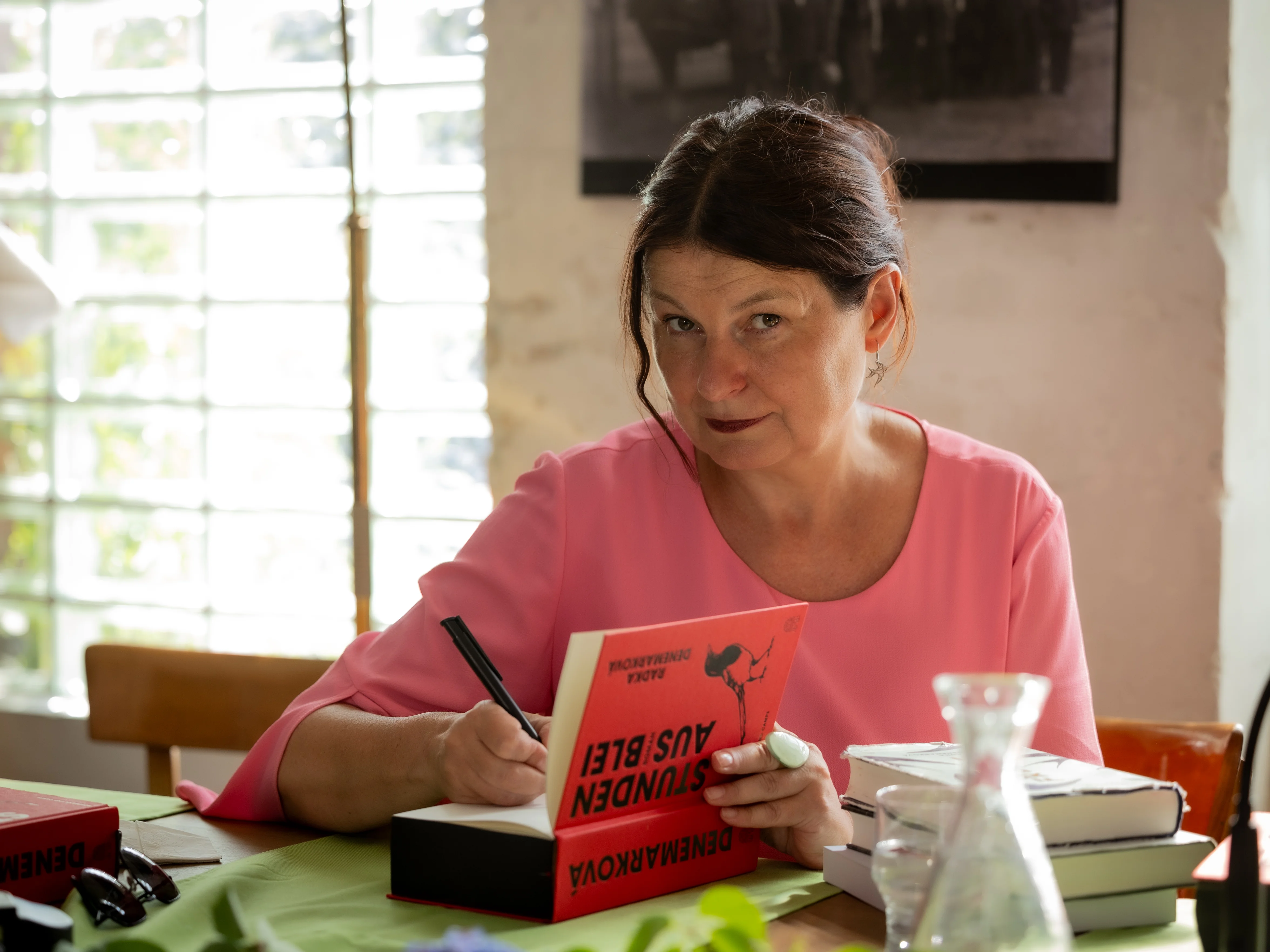
Image from Wikipedia
Image from Wikipedia
Radka Denemarková: One of the Most Uncompromising Voices in Contemporary Czech Literature
Literature as Resistance, Memory, and Artistic Precision
Radka Denemarková, born on March 14, 1968, in Kutná Hora as Radka Zajíčková, is one of the most prominent intellectuals in contemporary Czech literature. As a writer, literary historian, translator, playwright, screenwriter, and essayist, she combines literary creativity with political clarity and cultural depth. Her work revolves around memory, power, violence, historical politics, and the question of how language can describe a wounded society. Denemarková represents a musical career in literature: precisely composed, intensely performed, and with a stage presence that transforms texts into public events. ([radka-denemarkova.cz](https://radka-denemarkova.cz/?utm_source=openai))
Biography: Education, Intellectual Shaping, and Early Outlines
Denemarková studied German and Czech studies at Charles University in Prague and earned her doctorate in 1997. This education significantly shaped her later artistic development as it rooted her writing in two cultural spheres simultaneously: the realm of contemporary Czech literature and the German intellectual tradition. Early on, she combined philological precision with a strong sense of historical responsibility. Her work as a researcher at the Institute of Czech Literature of the Academy of Sciences and as a dramaturgical advisor at the Prague Theater Na zábradlí also sharpened her eye for structure, rhythm, and dramatic tension. ([en.wikipedia.org](https://en.wikipedia.org/wiki/Radka_Denemarkov%C3%A1?utm_source=openai))
These stages explain why her texts rarely appear purely narrative. They build arguments, expose contradictions, and often develop characters as bearers of historical conflicts. Denemarková writes not decoratively but analytically and incisively. Her literature's authority lies precisely in this: she observes power relations without yielding linguistically and shapes a resistant literary approach from personal and collective experience. ([radka-denemarkova.cz](https://radka-denemarkova.cz/?utm_source=openai))
The Breakthrough with Prose, Essays, and Theater
Early and significant milestones in her career include monographs, editorial work, and initial prose publications. Among other works, she published a monograph on theater and film director Evald Schorm, edited the anthology Zlatá šedesátá, and wrote later novels and dramatic texts that solidified her reputation as an uncompromising storyteller. It is particularly notable how closely prose, theater, and screenplay work remain intertwined in her work. Her literary development does not follow a linear genre logic but rather a steady intensification of themes and forms. ([radka-denemarkova.cz](https://radka-denemarkova.cz/autorka/?utm_source=openai))
An important milestone was the connection between literature and public debate. Denemarková is not interested in pleasant storytelling, but in moral friction, historical guilt, and the language of the repressed. Her texts do not offer escape but confrontation. This is where her cultural impact lies: she makes literature a space where memory contests simplification. ([radka-denemarkova.cz](https://radka-denemarkova.cz/?utm_source=openai))
Key Works and Literary Development
Some of her central books include A já pořád kdo to tluče (2005), Peníze od Hitlera (2006), Smrt, nebudeš se báti aneb Příběh Petra Lébla (2008), Kobold (2011), Příspěvek k dějinám radosti (2014), Hodiny z olova (2018), and Jako by se to všechno stalo včera. These works mark various stages of her artistic development: from a grotesquely dark post-war panorama to experimental narrative forms and politically charged contemporary novels. Denemarková continuously expands her expressive range without losing her themes. ([radka-denemarkova.cz](https://radka-denemarkova.cz/autorka/?utm_source=openai))
Peníze od Hitlera is a key text in her work as it compellingly addresses the violence of expulsion, the conflict over possession, and the fragmented memory of the post-war period. Kobold showcases the author's formal experimentalism, while Příspěvek k dějinám radosti raises questions about humanity in a politically tumultuous present. With Hodiny z olova, she ultimately opened a wide literary resonance space that connects China, Europe, and global power mechanisms. ([radka-denemarkova.cz](https://radka-denemarkova.cz/dilo/penize-od-hitlera/?utm_source=openai))
Style, Language, and Thematic Signature
Denemarková's style is dense, multifaceted, and marked by great linguistic discipline. Her texts work with historical upheavals, inner monologues, essayistic passages, and a strong visual energy. The composition of her books often resembles a literary arrangement in which each voice, each memory, and each leap in time serves a function. This creates prose that remains simultaneously emotional, intellectual, and politically readable. ([radka-denemarkova.cz](https://radka-denemarkova.cz/?utm_source=openai))
In terms of content, Denemarková focuses on German-Czech-Jewish relations, forms of exclusion, the aftermath of the Holocaust, and the intertwining of personal fate with large historical movements. Her texts therefore function like literary seismographs. They register power shifts early, clearly name societal hardening, and give a voice back to the victims of history. This combination of expertise and stance makes her an author of exceptional authority. ([radka-denemarkova.cz](https://radka-denemarkova.cz/?utm_source=openai))
Awards, Reception, and International Reach
Radka Denemarková is among the most frequently awarded Czech authors of her generation. She has received the Magnesia Litera four times in different categories; she is thus the only Czech writer with this record. Other honors include the Usedom Literature Prize in 2011, the Georg Dehio Book Prize in 2012, the Spycher Literature Prize Leuk in 2019, and the European Tolerance Prize for Democracy and Human Rights from the city of Villach in 2024. Her books have been translated into more than twenty languages, further enhancing her international visibility. ([en.wikipedia.org](https://en.wikipedia.org/wiki/Radka_Denemarkov%C3%A1?utm_source=openai))
Critical reception consistently highlights the linguistic power, formal independence, and moral consequence of her writing. In particular, Hodiny z olova has been perceived as a politically engaged major novel that intertwines contemporary China with Europe's crisis experiences. Peníze od Hitlera and Jako by se to všechno stalo včera are also regarded as books that do not treat historical questions in a museum-like manner but rather charge them with contemporary pressure. Denemarková has established herself as a literary authority whose works are read far beyond the Czech context. ([radka-denemarkova.cz](https://radka-denemarkova.cz/dilo/hodiny-z-olova/?utm_source=openai))
Current Projects and Presence
In 2024 and 2025, Denemarková remains an active and present author. Reports and author pages refer to her continued public activity, including readings, discussions, and international appearances. Furthermore, there is mention of a new novel project with a special focus on the Central European region, provisionally titled Schokoladenblut. This continues her work on significant historical and geopolitical questions. ([iwm.at](https://www.iwm.at/fellow/radka-denemarkova?utm_source=openai))
Her recent appearances show an author who does not dwell in the past. She speaks about the responsibility of writing, the freedom of literary expression, and the burden from which strong texts emerge. This relentlessness shapes her current stance: Denemarková views literature as an ongoing confrontation with reality, not as decorative accompaniment. ([praha.rozhlas.cz](https://praha.rozhlas.cz/sve-knihy-pisu-rukou-na-obycejne-skolni-sesity-s-kazdou-z-nich-nesmirne-bojuju-9174817?utm_source=openai))
Cultural Impact and Significance
Radka Denemarková has enriched Czech literature with a voice that combines historical knowledge, linguistic precision, and ethical consequence. Her books are present in debates about memory culture, gender, democracy, and authoritarian power structures. She works with historical material in such a way that it does not create mere retrospection, but a vibrant diagnosis of the present. This is precisely why her work possesses cultural relevance far beyond the literary sphere. ([radka-denemarkova.cz](https://radka-denemarkova.cz/?utm_source=openai))
As a translator of German literature and a mediator between language spaces, she also contributes to European literary connections. Her work demonstrates how productive multilinguality can be in contemporary literature. Denemarková stands for authorship that combines intellectual openness with stylistic rigor, achieving a rare literary credibility. Readers of her books encounter not a comfortable narrative, but a powerful art of precise observation. ([radka-denemarkova.cz](https://radka-denemarkova.cz/autorka/?utm_source=openai))
Conclusion: An Author of Rare Consequence and Great Presence
Radka Denemarková is compelling because she perceives literature as a moral and aesthetic challenge. Her biography, international reception, and thematic courage make her one of the most important voices in Central Europe. Her books merge historical depth, formal boldness, and political urgency into an unmistakable signature. Anyone interested in demanding contemporary literature should read her works and follow her appearances. ([radka-denemarkova.cz](https://radka-denemarkova.cz/?utm_source=openai))
Live, in conversation, or at a reading, the energy of this author unfolds particularly strongly. It becomes evident how much her language relies on presence, rhythm, and intellectual tension. Radka Denemarková is not a supporting character in the literary scene but an author who shapes it. Her books deserve attention, her stance respect, and her voice a firm place in the European cultural memory. ([praha.rozhlas.cz](https://praha.rozhlas.cz/sve-knihy-pisu-rukou-na-obycejne-skolni-sesity-s-kazdou-z-nich-nesmirne-bojuju-9174817?utm_source=openai))
Official Channels of Radka Denemarková:
- Instagram: no official profile found
- Facebook: no official profile found
- YouTube: no official profile found
- Spotify: no official profile found
- TikTok: no official profile found
Sources:
- Radka Denemarková – Official Website
- Radka Denemarková – Author Profile
- Radka Denemarková – Author
- Host Brno – Publisher Profile Radka Denemarková
- Embassy of the Czech Republic in Ottawa – Discussion with Radka Denemarková
- iROZHLAS – Report on Radka Denemarková and New Projects
- Czech Radio – Interviews and Contributions on Radka Denemarková
- Wikipedia: Radka Denemarková