
Camille Saint-Saëns
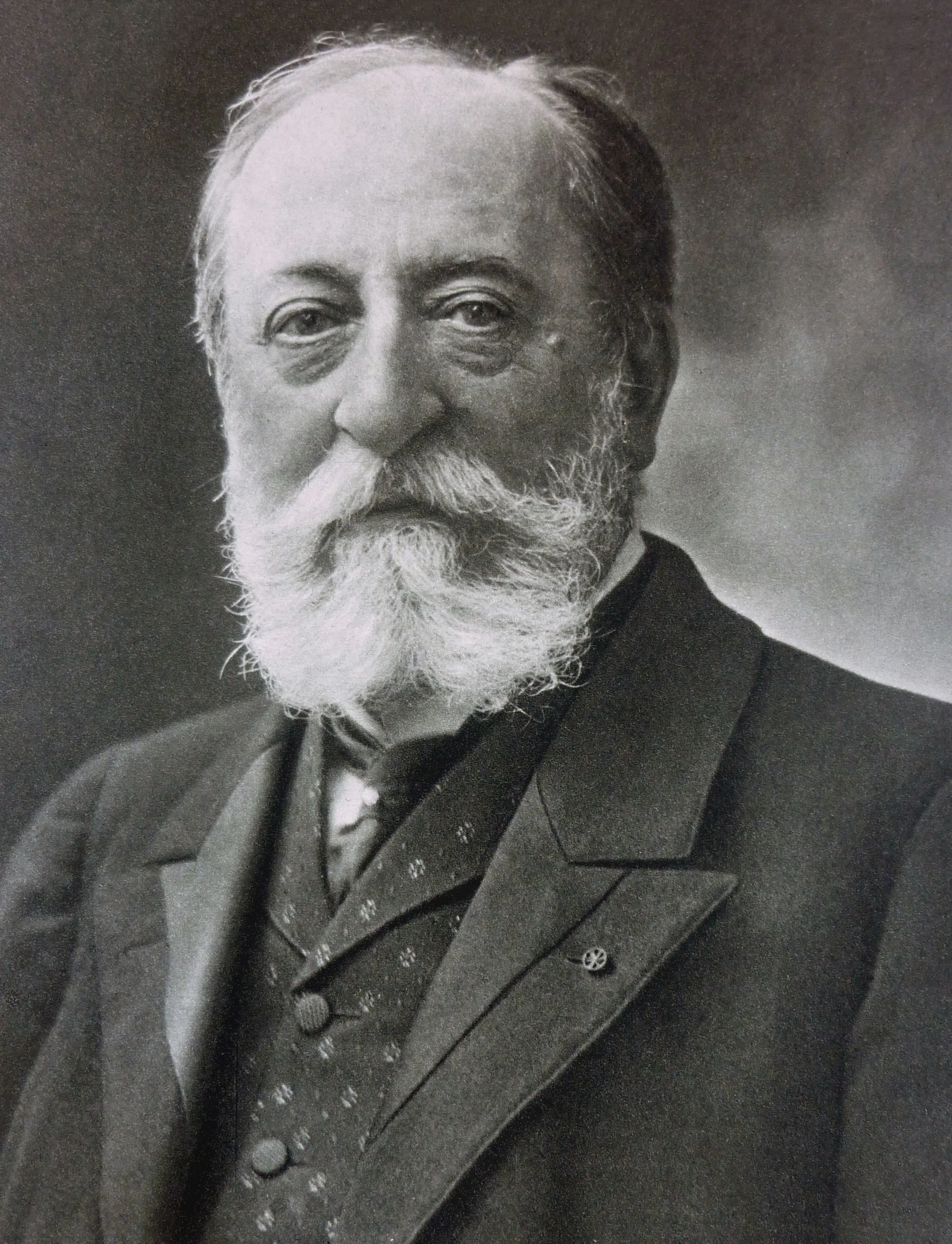
Image from Wikipedia
Image from Wikipedia
Camille Saint-Saëns – The Elegant Innovator of French Romanticism
A Master of Form, a Virtuoso on Stage, an Architect of Sound
Camille Saint-Saëns is one of the most colorful figures in European music history: a composer, pianist, organist, conductor, musicologist, and educator in one person. Born on October 9, 1835, in Paris, and died on December 16, 1921, in Algiers, he shaped French Romanticism with a rare mix of technical brilliance, stylistic clarity, and intellectual curiosity. His name still symbolizes the fascinating tension between classical rigor and vibrant creativity. ([deutschegrammophon.com](https://www.deutschegrammophon.com/en/composers/camille-saint-saens/biography))
Anyone who wishes to understand Saint-Saëns will discover not a romantic dreamer in the narrow sense, but a highly reflective musical thinker with enormous stage presence. His works combine elegance, transparency, and orchestral imagination with a discipline that is immediately noticeable in the music of the 19th century. This very balance often made him hard to access for audiences in France, while he was particularly appreciated in Great Britain and the USA. ([deutschegrammophon.com](https://www.deutschegrammophon.com/de/komponist-innen/camille-saint-saens/biografie))
Early Years: The Prodigy from Paris
Saint-Saëns showed his extraordinary talent early on. Before reaching the age of four, he had already composed his own pieces, at five he performed publicly, and by ten years old, he was already playing concerts with an orchestra and solo pieces at the Parisian Salle Pleyel. This early mastery laid the groundwork for a musical career that from the very beginning was marked by admiration and pressure to perform. ([deutschegrammophon.com](https://www.deutschegrammophon.com/en/composers/camille-saint-saens/biography))
After studying at the Paris Conservatory, he developed into a versatile musician of his generation. He became famous not only as a composer but also as an organist, initially at Saint-Merri, later at the Église de la Madeleine, one of the most important church venues in Paris. There, he established his reputation as an improviser of extraordinary sovereignty; his Sunday organ improvisations attracted prominent guests such as Clara Schumann, Sarasate, Rubinstein, and Liszt. ([deutschegrammophon.com](https://www.deutschegrammophon.com/de/komponist-innen/camille-saint-saens/biografie))
Career Highlights: Organist, Pianist, Organizer
Saint-Saëns was never confined to a single role. Alongside his compositional activities, he worked as a pianist, organist, journalist, and educator, thus remaining a musician who represented the 19th century in all its institutional breadth. In the 1860s, he taught at the École Niedermeyer, where he became one of the formative teachers of Gabriel Fauré and André Messager. His artistic authority stemmed equally from practice, education, and knowledge of repertoire. ([deutschegrammophon.com](https://www.deutschegrammophon.com/de/komponist-innen/camille-saint-saens/biografie))
A turning point was the founding of the Société nationale de musique in 1871 along with Romain Bussine. This institution aimed to promote new French chamber and orchestral music and became a central forum for contemporary creation. Here, Saint-Saëns showed himself as a cultural political force, not only composing but also creating a musical infrastructure. ([deutschegrammophon.com](https://www.deutschegrammophon.com/de/komponist-innen/camille-saint-saens/biografie))
The Breakthrough: Works that Shaped the Repertoire
Some of his most famous works include the Introduction and Rondo Capriccioso, the Second Piano Concerto, the First Cello Concerto, Danse macabre, the opera Samson et Dalila, the Third Violin Concerto, the Third Symphony, the “Organ Symphony,” and The Carnival of the Animals. These pieces are not only part of the permanent concert repertoire but also demonstrate how skillfully Saint-Saëns was able to combine genres, timbres, and musical dramaturgy. ([adp.library.ucsb.edu](https://adp.library.ucsb.edu/index.php/mastertalent/detail/102051/Saint-Sans_Camille))
Especially notable is his gift for revitalizing familiar forms. The piano concertos are regarded as prime examples of his pianistic thinking: virtuosic, well-structured, and full of surprising turns. The Second Piano Concerto begins with a Bach-like gesture, the Fourth Symphony works with nested formal ideas, and the Fifth Piano Concerto unfolds exotic hints and a final effect that extends far beyond classical boundaries. ([deutschegrammophon.com](https://www.deutschegrammophon.com/en/composers/camille-saint-saens/biography))
Composition Style: Classical Discipline with Colorful Imagination
Saint-Saëns’ style remains a unique form within European Romanticism: crystal clear in compositional technique, rich in instrumental details, and often deliberately distanced from exuberant emotionality. Deutsche Grammophon describes his works as an expression of an “agile mind” that reinterprets familiar forms and extracts unexpected colors from well-known instruments. This is precisely where his appeal lies: he is not a composer of overwhelming effect but one of highly precise impact. ([deutschegrammophon.com](https://www.deutschegrammophon.com/en/composers/camille-saint-saens/biography))
This characteristic made him hard to classify for some contemporaries. The Parisian audience regarded many of his works as too complicated, while he concurrently gained international recognition. In Great Britain and America, he was long considered the most significant living composer from France, while his star temporarily waned at home. This divided reception adds an additional cultural tension to his biography. ([deutschegrammophon.com](https://www.deutschegrammophon.com/de/komponist-innen/camille-saint-saens/biografie))
International Reputation and Critical Reception
Saint-Saëns was not only a French national composer but also a European figure. Britannica emphasizes that he is mainly remembered for his symphonic poems and the opera Samson et Dalila; at the same time, he is considered the first French composer to significantly shape the genre of symphonic poetry. His music combines classical architecture with dramatic expressiveness and thus remained permanently present in concert halls. ([britannica.com](https://www.britannica.com/biography/Camille-Saint-Saens?utm_source=openai))
Modern music historiography also highlights his importance as a mediator between tradition and renewal. Initially, he admired Schumann, Liszt, and Wagner, but later became a critic of Wagner's influence and also of Debussy. Despite these aesthetic positions, he enjoyed the respect of Fauré, Ravel, and the subsequent generation around Poulenc. This shows that Saint-Saëns was not a marginal phenomenon, but a key reference figure in French music. ([deutschegrammophon.com](https://www.deutschegrammophon.com/en/composers/camille-saint-saens/biography))
Later Years: Cosmopolitanism, Distance, and Unbroken Productivity
After personal crises and the separation from his wife, Saint-Saëns traveled extensively, particularly to Algeria. His last phase of life was characterized by enormous intellectual activity; he wrote about music, literature, and science and remained a public figure well into old age. The broad perspective of his life is also reflected in his music: it is rooted in France but never provincial. ([deutschegrammophon.com](https://www.deutschegrammophon.com/en/composers/camille-saint-saens/biography))
At the turn of the century, he shifted his focus more toward stage works. Although the French audience approached him with skepticism at times, his international status remained unchallenged. This dual position makes him exciting for today's listeners: Saint-Saëns embodies the classical authority of the 19th century while also being a compositional spirit that effortlessly attracts new forms. ([deutschegrammophon.com](https://www.deutschegrammophon.com/de/komponist-innen/camille-saint-saens/biografie))
Current Reception and Liveliness in the 21st Century
Even decades after his death, Saint-Saëns remains vibrant in concert life and musicology. The Société Camille Saint-Saëns continues to publish studies, volumes, and notes on new releases; in 2024 and 2025, new editions of the Cahiers Saint-Saëns will be released, along with information on current productions and recordings. This demonstrates how stable his place in the musical memory has remained. ([camille-saint-saens.org](https://camille-saint-saens.org/actualites/))
Additionally, there are new performances and recordings, such as the Second Piano Concerto, which will be presented in a 2025 ORF production featuring Bertrand Chamayou. Such programs prove that Saint-Saëns functions not just as a historical name but as a lively part of the repertoire. His music still speaks today through precision, brilliance, and structural elegance. ([oe1.orf.at](https://oe1.orf.at/programm/20250114/782160/Chamayou-spielt-Saint-Saens))
Conclusion: Why Camille Saint-Saëns Continues to Fascinate Today
Camille Saint-Saëns is compelling because he masterfully unites opposites: virtuosity and control, tradition and renewal, French elegance and international impact. He was a musical polymath with a keen sense for form, color, and audience. Anyone who hears his works experiences not mere romance but an unmistakable sonic thought process that continues to set standards. His music deserves to be rediscovered time and again – it resonates particularly directly and impressively in concert halls. ([deutschegrammophon.com](https://www.deutschegrammophon.com/en/composers/camille-saint-saens/biography))
Official Channels of Camille Saint-Saëns:
- Instagram: No official profile found
- Facebook: No official profile found
- YouTube: No official profile found
- Spotify: No official profile found
- TikTok: No official profile found
Sources:
- Deutsche Grammophon – Camille Saint-Saëns: Biography
- Deutsche Grammophon – Camille Saint-Saëns: Biography
- Britannica – Camille Saint-Saëns
- University of California, Santa Barbara – Discography of American Historical Recordings
- Société Camille Saint-Saëns – News
- ORF Ö1 – Chamayou plays Saint-Saëns
- Wikipedia: Image and text source
Upcoming Events
Carnival of the Animals - Schauspielhaus Neubrandenburg
Experience a musical journey through the animal world with “Carnival of the Animals” at Schauspielhaus Neubrandenburg. Admission is free!
Carnival of the Animals
A children's concert for the whole family with Saint-Saëns' music on May 13, 2026, at the Erfurt Theatre.
The Carnival of the Animals – Theater Erfurt
Attend the children's concert The Carnival of the Animals at the Theater Erfurt - a musical experience for the whole family.
Carnival of the Animals
Experience Saint-Saëns' famous work in a magical production for families.
Welte Concert: Unforgettable Pianists
Experience the masterpieces of Busoni, Saint-Saëns, and Gershwin on the Welte-Mignon at the Augustinermuseum Freiburg.
Samson and Delilah
An evening of opera full of seduction and force awaits you in the theater tent at Küchengarten: Samson and Delilah combines sound splendor, drama, and stage. 17.10.2026, #Schwerin
A Musical Christmas - Christmas Oratorio by Camille Saint-Saens
Festive concert magic in Bad Kissingen: A Musical Christmas combines great musical hits with Christmas songs in the Max-Littmann Hall. December 26, 2026, 8:00 PM, from 45.90 Euros. Now secure excitement for a glamorous evening. #BadKissing #MusicalChristmas