
Brìghde Chaimbeul
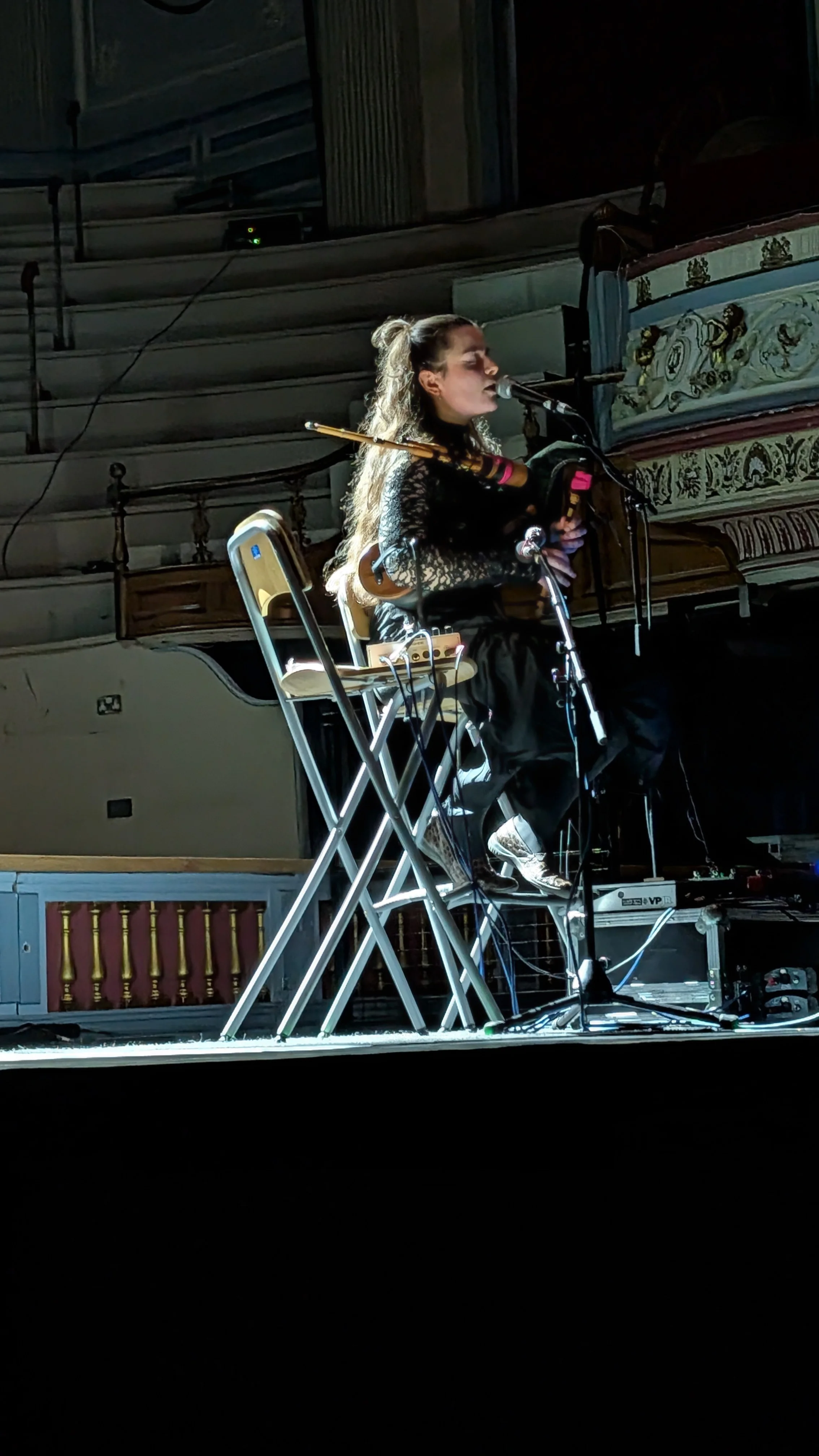
Image from Wikipedia
Image from Wikipedia
Brìghde Chaimbeul – The Poetic Avant-Garde of Scottish Smallpipes
A Musician Between Gaelic Tradition and Sonic Exploration
Brìghde Chaimbeul, born in 1998 on the Isle of Skye, is today one of the most exciting voices in experimental Celtic music. As a British-Scottish musician, singer, and virtuoso on Great Highland Bagpipes and Scottish Smallpipes, she merges her Gaelic heritage with a sonic curiosity that transcends the boundaries of folk tradition. Her work represents a musical career where cultural roots and radical openness are not opposites but rather a shared driving force in her artistic development. ([de.wikipedia.org](https://de.wikipedia.org/wiki/Br%C3%ACghde_Chaimbeul))
Early Influences: Language, Family, and First Musical Steps
Chaimbeul grew up speaking Gaelic and comes from an artistically inclined family: her father Aonghas Phàdraig Caimbeul is an author and radio journalist, her mother is a sculptor, and several siblings are also musically active. Before dedicating herself completely to the bagpipes, she learned violin and piano; at the age of seven, she began playing the bagpipe and received lessons from Niall Stewart. Early on, she successfully participated in solo competitions on the Great Highland Bagpipe, showcasing her technical discipline and stage presence at a young age. ([de.wikipedia.org](https://de.wikipedia.org/wiki/Br%C3%ACghde_Chaimbeul))
A pivotal turning point was her transition to the Scottish Smallpipes after Hamish Moore gifted her the instrument. From 2014, she developed her own playing style characterized by floating drones, controlled tension, and a trance-like continuity of sound. A scholarship from the Saltire Society also took her to Bulgaria, where she explored the local bagpipe tradition; Scandinavian and Cape Breton styles have also left their mark on her musical thinking. ([de.wikipedia.org](https://de.wikipedia.org/wiki/Br%C3%ìghde_Chaimbeul))
The Breakthrough: Awards, Recognition, and Opening to Experimentation
The early breakthrough came with awards that hold weight in the traditional scene: in 2016, she won the BBC Radio 2 Young Folk Award, followed by the BBC Radio 2 Horizon Award in 2019. These honors not only mark talent but also an artistic independence that quickly evolved from competition success to a distinctive signature. The official website describes her as a leading representative of Celtic experimentalism, and therein lies her strength: in reinterpreting a centuries-old instrument for the 21st century. ([de.wikipedia.org](https://de.wikipedia.org/wiki/BrÌghde_Chaimbeul))
Her performances also soon exceeded the narrow confines of folk repertoire. In 2021, she performed on stage at the opening ceremony of the UN Climate Conference in Glasgow (COP 26), later playing at major international festivals and reaching an audience far beyond the traditional folk scene. The Skinny specifically described her development in 2023 as a way to bring the Smallpipes sound "to a global stage." ([de.wikipedia.org](https://de.wikipedia.org/wiki/BrÌghde_Chaimbeul))
Discography: From Debut to Current Artistic Maturity
Her debut album The Reeling was released in 2019 and laid the foundation for her current reputation. The album, released on River Lea Recordings, primarily combines Gaelic tunes with a distinctive production aesthetic: recorded live, acoustically close, and atmospherically dense. The Quietus emphasized how simple the music initially appears before revealing its full complexity; this is at the core of her art. ([brighdechaimbeul.bandcamp.com](https://brighdechaimbeul.bandcamp.com/album/the-reeling?utm_source=openai))
With Carry Them With Us, she reached a new level in 2023. The album fuses textures from drone, jazz, and folklore, opening up the Smallpipes for collaborations with Colin Stetson and received significant acclaim in the international music press. According to Bandcamp and Wikipedia, it was listed by The Guardian as one of the best folk albums of the year and placed among the best albums of 2023 by The Quietus; the album solidified her position as an experimental force with high compositional demands. ([de.wikipedia.org](https://de.wikipedia.org/wiki/BrÌghde_Chaimbeul))
Her third album Sunwise is set to be released in 2025 and shifts the emphasis even further towards tradition, mythology, and sonic meditation. Bandcamp describes the album as a bold step that intertwines experiment and tradition more closely, while the recordings draw on field research, traditional sources, and family voices. The title represents a music that feels alive rather than museum-like: archaic in material but modern in form. ([brighdechaimbeul.bandcamp.com](https://brighdechaimbeul.bandcamp.com/album/sunwise?from=discover_page))
Collaborations, Influences, and Artistic Partnerships
Chaimbeul's career thrives on encounters. She has collaborated with Aidan O’Rourke, Ross Ainslie, John McSherry, Paul Meehan, Martin Green, Carlos Núñez, and Allan MacDonald; she is also featured on albums by Caroline Polachek, Aerialists, and Matt Carmichael. Particularly significant is her collaboration with Colin Stetson, which transformed her sound towards an expanded, physically felt drone and gained her international attention. ([de.wikipedia.org](https://de.wikipedia.org/wiki/BrÌghde_Chaimbeul))
Stylistically, she is at home in several worlds. The official website names ambient, avant-garde, and electronic music as influences on her recent works, while her Smallpipes playing refers to a much broader network of piping traditions. Critics highlight this very tension: the ability to not reproduce historical forms but to use them as material for new compositions, new arrangement ideas, and her own sonic architecture. ([brichaimbeul.com](https://www.brichaimbeul.com/))
Style and Sound Language: Drone, Trance, and Gaelic Imagination
Brìghde Chaimbeul's music thrives on the concentration on the tone itself. The Scottish Smallpipes in her hands do not create a folkloric backdrop but rather a finely balanced system of drone, melody, and breath tension, reminiscent of minimal music, ritual, and improvisation at once. The Quietus describes this music as something that flows like water from the instrument, eventually revealing its compositional depth. ([thequietus.com](https://thequietus.com/quietus-reviews/brghde-chaimbeul-the-reeling-review/))
Her special authority lies in this: she does not merely play a historical instrument but updates a cultural practice. Her playing is technically virtuosic yet never self-serving; it combines ornamentation, rhythmic precision, and an almost hallucinatory continuity of sound. This makes the music feel both grounded and transcendent, as if it emerges from a landscape that is real, mythical, and contemporary at once. ([brichaimbeul.com](https://www.brichaimbeul.com/))
Critical Reception and Cultural Impact
For years, the music press has recognized Chaimbeul as an artist who opens new spaces for Celtic music. The Quietus, The Skinny, Vogue, and other media describe her as a musician who does not conserve tradition but questions, transforms, and places it in new aesthetic contexts. Her combination of folklore, experiment, drone, and improvisation makes her an important figure within a young, internationally recognized Celtic contemporary music scene. ([thequietus.com](https://thequietus.com/quietus-reviews/brghde-chaimbeul-the-reeling-review/))
Her cultural influence also lies in the visibility of an instrument that has long been considered niche. Through her performances at festivals like Big Ears, Le Guess Who?, and Supersonic, as well as her collaborations with pop, jazz, and avant-garde artists, the Smallpipes have become an instrument with new reach. Thus, Chaimbeul acts not only as a virtuoso but also as a mediator of a vibrant Gaelic music culture. ([brighdechaimbeul.bandcamp.com](https://brighdechaimbeul.bandcamp.com/album/sunwise?from=discover_page))
Current Projects and Releases
With Sunwise, Chaimbeul continues her artistic development consistently in 2025. The official website announced the album as her latest work; the Bandcamp release states a release date of June 27, 2025, and refers to additional live dates in Europe and North America. Simultaneously, her tour page documents an ongoing international stage presence that brings her music into ever new contexts. ([brichaimbeul.com](https://www.brichaimbeul.com/))
Recent releases also hint at a productive tension between solo work, collaborations, and live repertoire. With individual tracks, album formats, and guest contributions, she remains present without committing to a single format. This very openness makes her musical career so exciting: each release expands the horizon rather than repeating it. ([brighdechaimbeul.bandcamp.com](https://brighdechaimbeul.bandcamp.com/album/sunwise?from=discover_page))
Voices of the Fans
The audience also responds to this music with palpable enthusiasm. On Bandcamp, Sunwise is celebrated as a “fantastic album”; another comment describes the music as “authentic” and emphasizes its immediate impact. Such reactions show that Chaimbeul's sound language not only convinces critics but also reaches an audience that hears intensity, depth, and autonomy in her music. ([brighdechaimbeul.bandcamp.com](https://brighdechaimbeul.bandcamp.com/album/carry-them-with-us?from=embed))
Conclusion: An Artist Transforming Tradition for the Future
Brìghde Chaimbeul is an exceptional musician because she transforms the Scottish Smallpipes into more than just a historical instrument. She shapes a unique sound world from Gaelic tradition, experimental production, and virtuosic stage presence that is both intellectually stimulating and emotionally immediate. Those who want to understand how tradition remains vibrant today will find an impressive example in her discography. Live, this music unfolds its full power – intense, hypnotic, and full of presence. ([brichaimbeul.com](https://www.brichaimbeul.com/))
Official Channels of Brìghde Chaimbeul:
- Instagram: https://www.instagram.com/brichaimbeul/
- Facebook: https://www.facebook.com/brichaimbeul
- YouTube: No official profile found
- Spotify: No official profile found
- TikTok: No official profile found
Sources:
- Brìghde Chaimbeul – Official Website
- Brìghde Chaimbeul – Bandcamp
- Wikipedia – Brìghde Chaimbeul
- The Quietus – Brìghde Chaimbeul: The Reeling
- The Skinny – Brìghde Chaimbeul on bringing the smallpipes to a big audience
- Vogue France – Brìghde Chaimbeul Propels Celtic Folk into the 21st Century
- Brìghde Chaimbeul – Tour
- Brìghde Chaimbeul – Contact