Interreligious Events & Culture in Passau
Interreligious Events & Cultural Festivals in Passau (Preview & Orientation)
Passau is known for its large folk festivals, a dense cultural program, and formats that enable dialogue between religions and cultures. This overview deliberately looks ahead: What types of events can be expected in Passau in the future, where are they typically announced – and how do you find reliable, up-to-date information as soon as dates are published?
Passau's Festival Year: Tradition, Markets, Folk Festivals
If you want to visit Passau in the coming months or years, you can generally expect a varied calendar: folk festivals, markets, concerts, exhibitions, university events, as well as religious and interreligious offerings complement each other. Many formats are recurring but are scheduled and announced anew each year.
To ensure you only use reliable information, the rule of thumb is: As soon as concrete dates, locations, and program points are set, they first appear on official event pages (city, organizers, churches/associations, cultural institutions). The most important entry points can be found further down in the section “Finding Events”.
Dult & Christmas Market: Tradition, Encounters, City Life
Passau Dult (Spring/Autumn): Folk Festival with Generational Mix
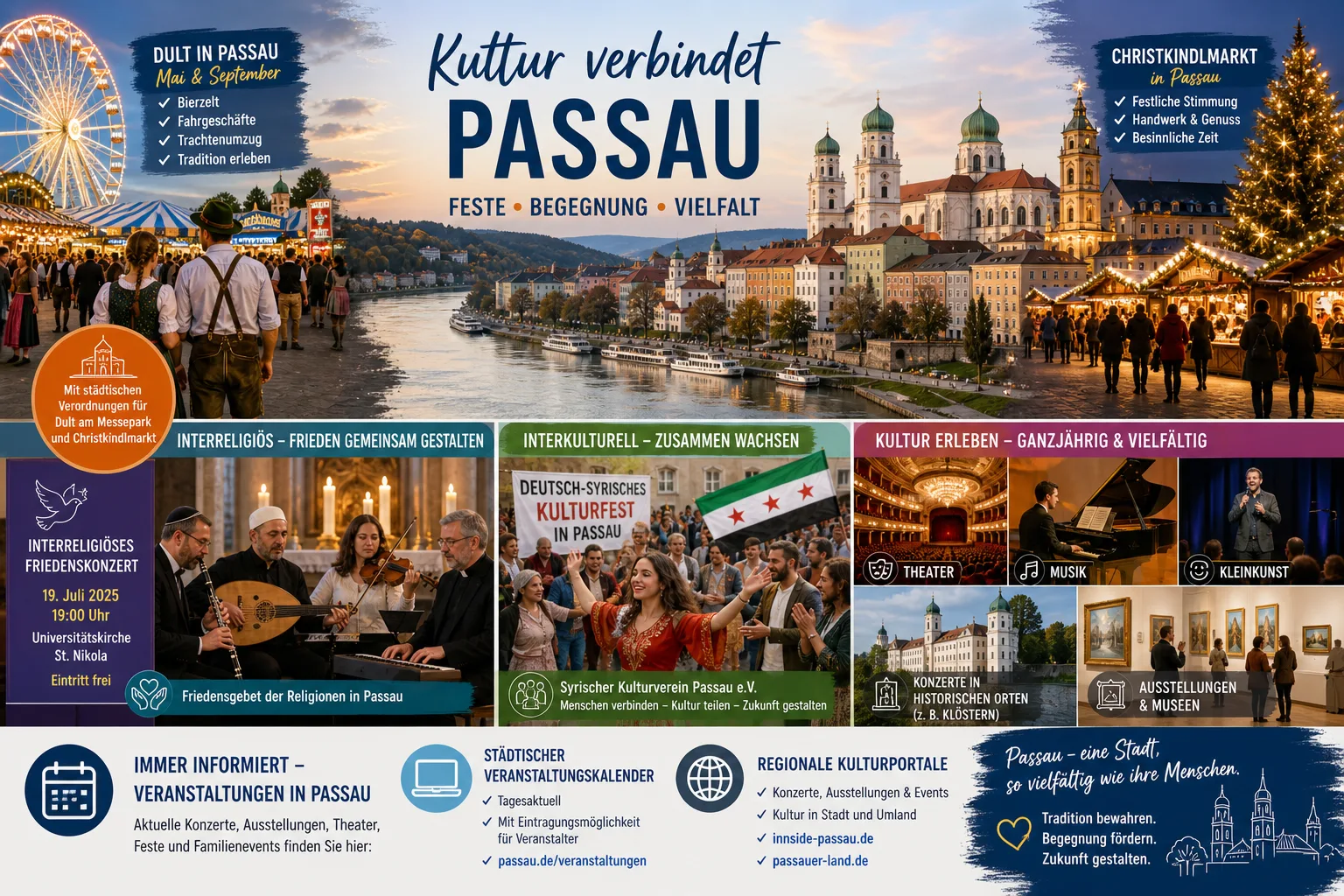
The Passau Dult is one of the city's major, regularly recurring folk festivals. Usually, there is an edition in spring and one in autumn. Visitors can typically expect a program of festival tents, rides, market stalls, and gastronomic offerings.
For many, the Dult is above all a social meeting point: You can start conversations without prior knowledge, experience Passau's everyday culture, and see how different worlds of life come together in a shared festive environment. If you are new to the city (or just visiting), a folk festival is often the lowest-threshold entry to “get a feel” for Passau.
Christmas Market: Winter Tradition in the Old Town
During Advent, you can regularly expect a Christmas market in Passau. Such markets combine crafts, culinary delights, and stage programs (e.g., choirs or brass groups) and are also a place where visitors from various backgrounds naturally mingle side by side.
Why Folk Festivals Are Relevant for Belonging & Integration
Folk festivals and markets are not “just” entertainment: They create contacts without access barriers (no scene affiliation, no perfect language skills, no prior knowledge). Especially for newcomers, such occasions can be important in the future to get to know local habits, conversation starters, and social networks. Integration is often shown here in practice: through shared experiences, shared rituals, consideration, and curiosity.
Interreligious Formats: Peace Concerts & Peace Prayers
Peace Concerts: Music as a Common Language
In Passau, interreligious or dialogue-oriented concerts are also conceivable in the future, where music is the central connecting element. Such formats are often planned in acoustically strong spaces such as churches or cultural venues because they offer a special atmosphere for listening, respect, and encounters.
If you are looking for an interreligious concert, look for announcements with keywords such as “interreligious,” “dialogue,” “peace,” “encounter,” or “benefit,” as well as the mention of several participating communities or ensembles. Reputable organizers usually transparently state the program, participants, admission rules, and, if applicable, accessibility information.
Peace Prayers and Encounter Evenings: Silence, Text, Exchange
In addition to concerts, peace prayers, dialogue evenings, or thematic encounter formats are also possible in the future, where representatives of different faiths present texts, perspectives, and rituals side by side in a respectful setting. Such events are often explicitly open to people without religious affiliation.
Important: Transparency is especially relevant for interreligious offerings. Pay attention to a clear description of who is inviting, who is involved, how photo/video recordings are handled, and whether there are conversation rules (e.g., respectful language, no proselytizing).
Intercultural Festivals: Music, Food, Exchange
Cultural Festivals with an International Focus
In the coming years, intercultural cultural festivals can still be expected in Passau, bringing together music, dance, culinary delights, and personal stories. Typical components are stage programs, information stands from associations, hands-on activities for children, and food offerings that open up new worlds of taste.
How to Recognize a Good Intercultural Festival
- Cooperations (e.g., associations, cultural sponsors, educational actors) are openly named.
- Program & times are concrete and easy to find.
- Framework conditions (admission, languages, accessibility, weather backup) are explained.
- Respectful presentation: no clichés, but real participation of the communities.
How Such Festivals Can Practically Support Integration
When people organize, perform, cook, or moderate together, contacts are made that go beyond the day of the event. For visitors, it is an opportunity to ask questions, check prejudices, and get to know new perspectives – without pressure, but with real exchange.
Venues & Cultural Series: Where Passau Shows Culture
Historic Spaces as a Cultural Backdrop
Passau offers many places where cultural programs can take place in the future: historic halls, church spaces, university contexts, and municipal venues. Especially in a city with distinctive architecture, the venue is often part of the experience – for example, when a concert lives from the acoustics of a vaulted ceiling or the effect of a reading comes from the intimacy of a small hall.
Small but Program-Strong: Short Distances, High Density
The cultural landscape in Passau is manageable compared to metropolises, but short distances allow for spontaneous combinations: exhibition plus concert, city walk plus evening program. For planning, it is worth checking calendars (see below), as new series, cooperations, and special formats can be added regularly.
Finding Events: Calendars, Portals, Official Channels
1) Official City and Tourism Calendars
For future dates, the most reliable entry point is the official event calendar (city or tourism). Announcements are centrally bundled there, often including filters (date, category, target group) and basic information such as location, time, admission, and organizer contact.
2) Organizers' Channels
For interreligious or intercultural formats, it is also recommended to check the websites and social media channels of the inviting organizations (e.g., cultural associations, communities, educational providers, university groups). Program updates often appear there first (e.g., line-up, participants, registration information).
3) Regional Culture Portals & Newsletters
Regional culture portals and newsletters can be a good addition if you are looking for curated tips. For final planning (arrival, admission, last-minute changes), however, the official primary source of the organizer should always be decisive.
Outlook: How Encounter Formats Can Further Develop
For Passau, it is plausible in the coming years that encounter formats will continue to gain importance: Cooperations between cultural actors, associations, and religious communities can bring forth new programs, such as conversation concerts, workshops, or youth-oriented projects. Hybrid elements (livestreams, digital accompanying formats) can also help lower barriers.
If you want to get involved yourself, the easiest next step is usually: subscribe to a calendar, attend an open event, and if interested, ask the organizer directly about participation opportunities (e.g., helping, translating, stage/tech, children's program, public relations).