Leisure for Students in Passau: affordable and cool on the Danube
Leisure for Students in Passau (from now until next semester): affordable, spontaneous, cool
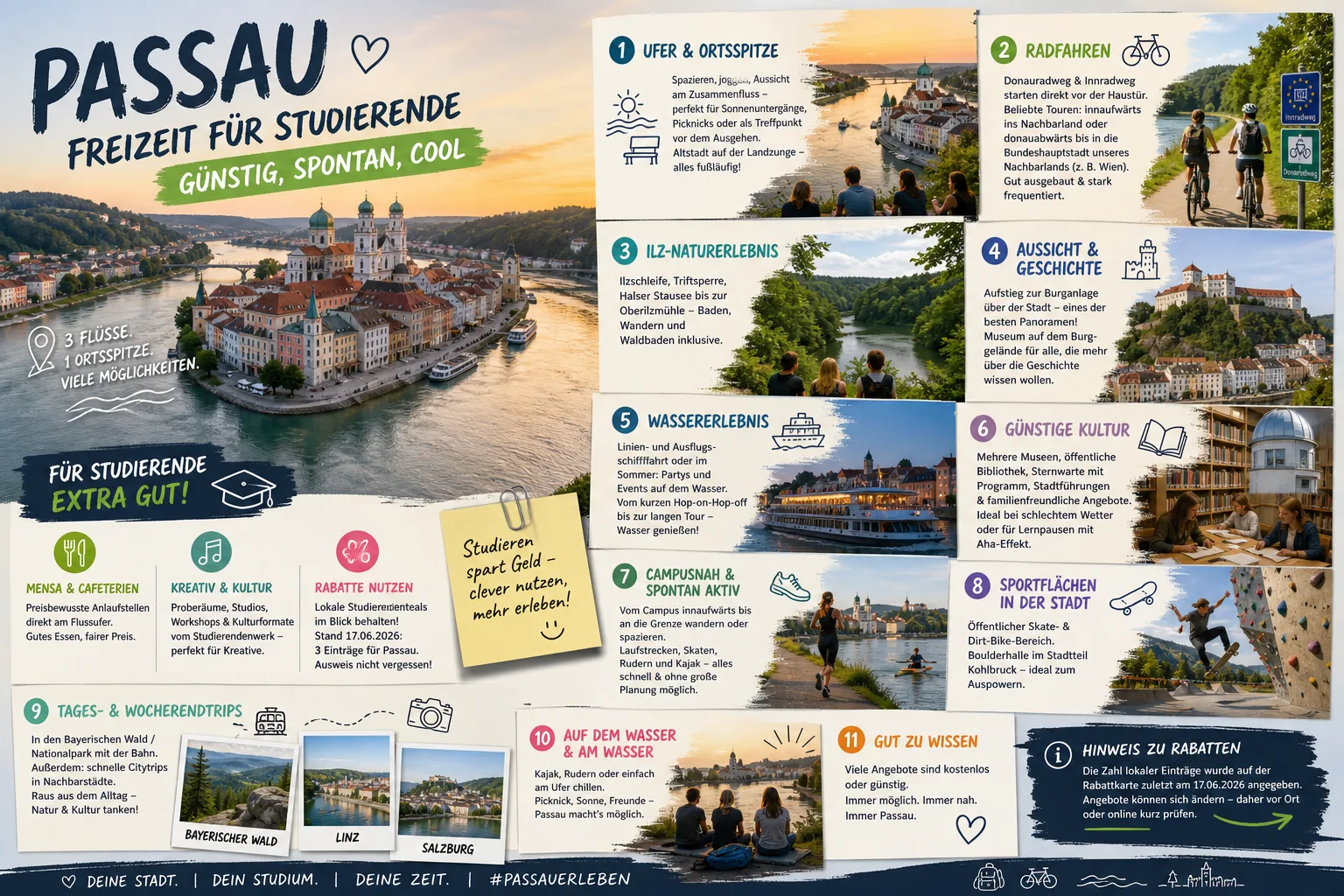
Ideas for the coming weeks and semesters in Passau: spontaneous riverside moments, cycling and walking routes, nature at the Ilz, cultural events on a small budget, as well as day trips you can plan flexibly.
What you can quickly experience in Passau in the future
In the coming days, you will probably notice that many things in Passau happen spontaneously: a short break by the water after a lecture, a sunset with friends, or a mini-excursion that feels "far away" even though it starts just a few steps away. If you are new to the city, one thing will especially accompany you: leisure plans can often be implemented at short notice here, without needing much budget or preparation.
This guide will help you fill your next free afternoons, evenings, and weekends in Passau: affordable, flexible, and still special. All tips are formulated so that you can adapt them in the future to the weather, study phases, and your budget.
In the next weeks: Riverside time, Ortsspitze & Old Town walks
In the coming weeks, you will quickly find your standard spots along the banks of the Danube and Inn: for short walks, to catch your breath during lunch break, or as an "after uni" meeting point. Such routines are especially practical if you only have a 20–60 minute window between seminars and study phases.
A fixed point for many students is often the Ortsspitze: If you plan it into your next evenings in good weather, you will experience picnics, conversations, and short study sessions outdoors there. Especially at the end of the day, the view of the water and the city skyline is worthwhile.
Also in the future, a walk through the old town will remain one of the cheapest "all-in-one" options: You can grab a coffee, look for a quiet spot, discover small shops, and end your round by the river. If you only plan one activity for a weekday, a short old town loop will often be enough to get you "out of your head" again.
- For short windows: 20–30 minutes riverside walk instead of "doing nothing".
- For social evenings: Ortsspitze as a meeting point, then old town walk.
- For study phases: Movement by the water as a conscious end to a study session.
From the next free day: Cycling along the Danube & Inn (without much planning)
If you want to get "far out" as cheaply as possible in the next weeks or in the coming semester, the bicycle will be a real key for you. In the future, you can take small after-work rides or add a longer route along the Danube or Inn on a free day, without having to plan complicated routes.
For future tours, it is especially helpful that the large cycle paths along the rivers are good for orientation. This will also allow you to start spontaneously alone or in pairs: a round "to the next nice bench", a stop for a drink, or a longer ride if you want to clear your head.
If you don't have your own bike yet, you will typically find options in Passau and around the university to organize a bike temporarily (e.g. rental/sharing or privately among friends). For longer tours, it will be worth it to briefly check for safety in advance (lights, brakes, lock) and keep the most important traffic rules in mind.
- Mini tour (30–60 minutes): Along the river, "clear your head" once, back.
- Half-day tour: Riverside route + break + return, without time pressure.
- Project for the semester break: Multi-day stages, if you consciously plan time for it.
In the next study break: Ilz, Triftsperre & nature breaks you can repeat
If you are looking for a nature option in the coming months that feels like a reset, you will get a lot out of walk and route ideas around the Ilz. Especially on days when you "just want to get out for a bit", an hour in the green can bring more in the future than an afternoon on your phone.
For your next weekends, you can plan tours so that they work without much equipment: water bottle, small snacks, comfortable shoes. In warm periods, you will probably find places where you can just sit, read, or walk quietly along the water. If you build this up as a ritual (e.g. after an exam or before an intensive study week), it will be easier for you to break stress cycles.
Important for your future excursions: Depending on the weather, watch out for slippery paths, follow signs, and stay on safe routes at dusk. If you go to the water in summer, plan so that you don't have to rush back.
In the coming semesters: Cultural moments on a small budget (viewpoints, museums, observatory)
For the next few months, it is worth thinking of culture in Passau like a modular system: In the future, you will combine free viewpoints with individual, targeted visits to exhibitions or programs when it fits your schedule and budget.
If you plan a "Passau overview" day soon, a view over the city will often be the strongest start for you: You get your bearings, take good photos, and can remember the next places you want to visit later.
For upcoming rainy days, you will also need options that don't automatically mean "shopping": Museums and library areas (depending on what's available) can then become your reliable alternatives. And if you plan something unusual for an evening, you will find a change of pace with astronomical programs (e.g. observation evenings/guided tours, if offered) that feels noticeably different from standard nights out.
Since programs, opening hours, and conditions can change, it will be worth it for you to briefly check the official pages or notices before your visit.
From next week: Campus life, cafés & water experiences as a spontaneous program
In the coming weeks, you will quickly build "everyday islands" around the campus: a quick coffee before the seminar, a place to read, or a meeting point by the water. Such micro-breaks will be especially valuable when your schedule is tight.
If you want to study in cafés in the future, plan so that you don't block anyone and order what suits you. Many students use such places as a switch between "uni mode" and "leisure mode": work concentrated for an hour, then consciously go outside and walk along the river.
For the warmer months, you can also set water perspectives as a highlight: If excursions or round trips are offered, a short trip is often exactly the change of perspective that feels like a mini-vacation. If you want to get on the water yourself (e.g. rowing/kayaking, if possible in courses/teams), only plan this in the future with reputable providers, appropriate safety rules, and realistic self-assessment.
For the coming semester: Discounts, day trips & a budget plan that really works
To keep leisure time really affordable in the next few months, a simple rule will help you: first free basics, then targeted spending. You will see that riverside paths, walks, viewpoints, and self-organized picnics often provide the strongest experiences without needing entry fees or consumption.
Additionally, in the coming semesters you will repeatedly find offers specifically tailored to students (e.g. discounts, university offers, promotions). Since such conditions do not remain the same permanently, the best savings hack for the future is: check briefly beforehand, then decide—instead of being surprised at the entrance.
If you want bigger changes of scenery, you can plan day or weekend trips for future free days so that they remain realistic with trains and regional tickets. Destinations in nature (e.g. hiking areas in the Bavarian Forest) can often be divided into "just start" and "expand later": first an easy route, later a longer tour.
- Budget-safe: 1–2 fixed free favorite routes (riverside/green) for each week.
- Flexible: A "bad weather list" (museum/library/café with study time window).
- Plannable: 1 day trip per month (or per study block as a reward), without stress.