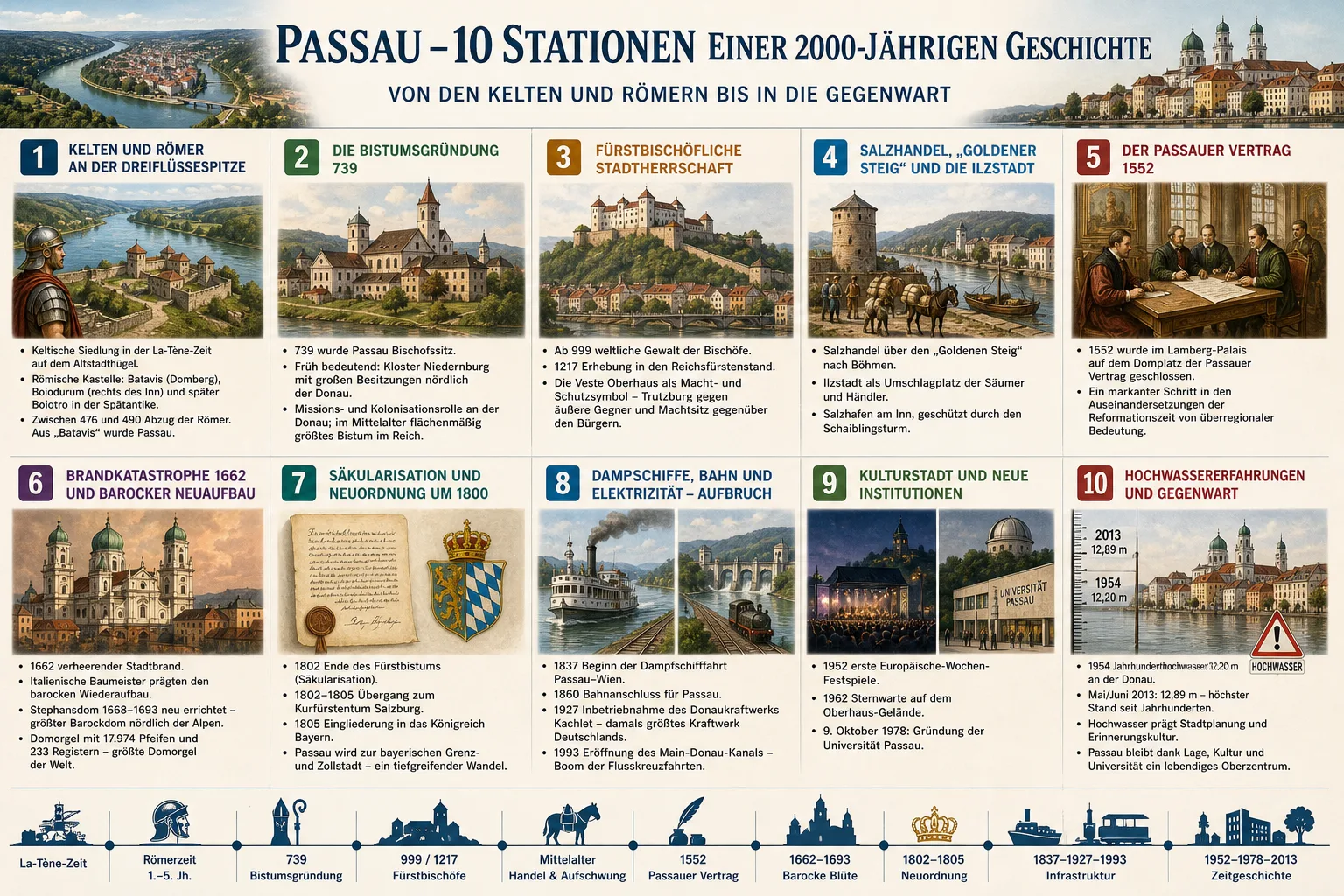
The History of Passau in 10 Stops
The History of Passau – Excitingly Told in 10 Stops (Program Preview for Upcoming Dates)
This page announces a future, guided journey through time in ten stops – as a walk through Passau with a view of Dreiflüsseeck, Old Town, Cathedral Hill, and Veste Oberhaus. The focus is on what you can expect during the upcoming tours: topics, stops, schedule, participation info, and
Overview: How the Journey Through Time Works
The upcoming tour is planned as a chronologically structured city walk: Each stop sets a thematic focus (archaeology, urban development, trade, politics, architecture, technology, culture, flood protection) and connects it to a specific location in the cityscape. You will receive orientation aids, visual material (historical views/plans), and clear “What you see here” explanations so that you can recognize the places on your own later.
The tour is designed to offer something new for both first-time visitors and Passau experts – for example, through changes in perspective (lines of sight, elevations, shorelines) and through brief, understandable explanations of terms often heard in Passau (e.g., Cathedral Hill, Ortspitze, Ilzstadt, Oberhaus).
The 10 Stops (Topics & Experiences)
1) Understanding the Three Rivers: Landscape, Location, Routes
To start, an orientation at the Three Rivers Confluence is planned. You will learn how the tour uses the river landscape as a “red thread” – from viewpoints to walking routes to questions like: Why do settlement cores, trading places, and protective structures arise in such locations?
2) Early Traces & Archaeology: What Lies Beneath the Streets
This stop is planned as an introduction to archaeological time layers: What types of finds and features play a role in Passau, how are they documented, and how can you read “invisible” history in today’s city layout without seeing excavations?
3) Cathedral Hill as Center: Power, Administration, Everyday Life
At Cathedral Hill, the focus is on the logic of centers: Which types of buildings and squares typically stand for religious, administrative, and representative functions – and how can you recognize these functions during the tour?
4) Monasteries, Collegiate Churches, Education: Institutions in the Urban Space
A section is planned focusing on institutional history: How do religious institutions shape neighborhoods, route relationships, and property structures, and how do such influences change over time?
5) Veste Oberhaus: Perspective from Above
The stop at Veste Oberhaus is designed as a “panorama reading”: You will learn how to explain urban development and protection logic in an understandable way using the topography (ridge, river bends, bottlenecks). The view from above is used as a tool to spatially classify the next stops.
6) Trade & Logistics: Markets, Warehouses, Transshipment Points
The focus here is on trade routes and urban infrastructure: What clues do riverbanks, squares, and building types provide about the flow of goods? And how can terms like customs, staple, storage, and transshipment be vividly explained in the cityscape?
7) Politics & Negotiations: When Passau Becomes a Stage
This stop is planned as a “place + documents” format: Using selected, reliably transmitted sources (e.g., classifications from museums/archives and academic representations), it is explained how political events are located in the urban space – without dramatization, but with clear terms and roles of actors.
8) Cityscape & Reconstruction: Why Passau Looks Baroque
This stop is dedicated to the cityscape: Which features (facade rhythm, sequence of squares, lines of sight) are explained as “typically baroque” during the upcoming tour, and how can phases of remodeling and reconstruction be recognized in the existing buildings?
9) Technology on the Danube: Energy, Locks, Mobility
A comprehensible introduction to river use and technology is planned: What does regulation mean, what do locks accomplish, how does infrastructure influence the city relationships on both banks – and what should visitors pay attention to in order to recognize traces of technology in everyday life?
10) City of Culture & University: Present with a View to the Future
To conclude, the tour connects planned topics “culture,” “university,” and “Europe” with today’s locations: Which formats (concerts, festivals, lectures, exhibitions) and which perspectives (studies, research, international guests) shape future city life – and how can participants plan suitable next steps (own explorations, museum visit, concert evening)?
Schedule, Duration, Language & Group Size
- Format: Guided city walk in 10 stops, with short walks in between and stops for viewing/explanation.
- Duration (approximate): about 90–150 minutes, depending on route, weather, and group size.
- Languages: Primarily German; additional languages may be available for certain dates, if offered.
- Group size: Small to medium groups are planned, so questions can be asked and the group can move well in the old town.
- Bring: Comfortable shoes, weatherproof clothing, drinking water; sun hat in sunny weather.
Specific start times, booking methods, and ticket prices (if applicable) will be published with the official date announcement (e.g., by organizer, tourist information, or program partner).
Accessibility, Weather & Safety
Passau has varied topography (river paths, inclines, cobblestones). Therefore, notes on the route are planned for upcoming dates:
- Mobility: It is recommended to ask in advance for a variant with less incline if needed.
- Weather: In case of heavy rain, storms, or flooding, parts of the river paths may be closed in the future; the tour is planned so that alternative routes are possible.
- Safety: At riverbanks, stairs, and viewpoints: keep a distance from the edge, keep the group together, hold children by the hand.
If you need to consider medical conditions (e.g., walking difficulties), please clarify this directly with the respective organizer of the specific date in advance.
Accompanying Materials & Learning Value
For the upcoming tours, easy-to-understand materials are planned so you can better retain and later deepen the content:
- Map of the 10 stops (orientation in the city, useful photo spots).
- Glossary sheet (e.g., Cathedral Hill, Residence, Customs, Shoreline, Line of Sight).
- Recommendations for further study (museums, official information pages, selected literature).
The focus is on reliable classification instead of “myths”: Statements during the tour are identified as documented information, plausible interpretation, or open research question.
Sources & Further Links
- City of Passau – Official Information — Basic info on city, culture, infrastructure (accessed 2026-09-16)
- Diocese of Passau – Official Information — Background on church institutions and offerings (accessed 2026-09-16)
- University of Passau – Official Information — Information on the university and events (accessed 2026-09-16)
- Bavarian State Office for Monument Protection — Basics on monument protection, methodology, and understanding (accessed 2026-09-16)
- House of Bavarian History — Context for Bavarian state history (accessed 2026-09-16)