Arrival at Events in Passau: Train, Bus & Car
Arrival at the Biggest Events in Passau: Train, Bus & Car (Planning for Upcoming Event Days)
How to get to future major events in Passau: Arrival by train, bus or car, notes on construction and timetable situations 2026, transfers at the station/ZOB, parking and the “last mile”.
The Basic Principle: Stress-Free to the “Last Mile”
When major events are coming up in Passau, it’s rarely the long-distance journey that determines your mood – but the last few kilometers: Changing at the main station, the way from the ZOB to the right stop, or the question of whether you’ll still find a parking space with your car in the center.
The good news: Passau is compact. If you plan your arrival so that you switch to public transport (city bus/shuttle) or short walks as early as possible, you reduce the risk of traffic jams, search time, and stress – especially on days with high visitor numbers.
Arriving in Passau by Train (Looking Ahead to 2026)
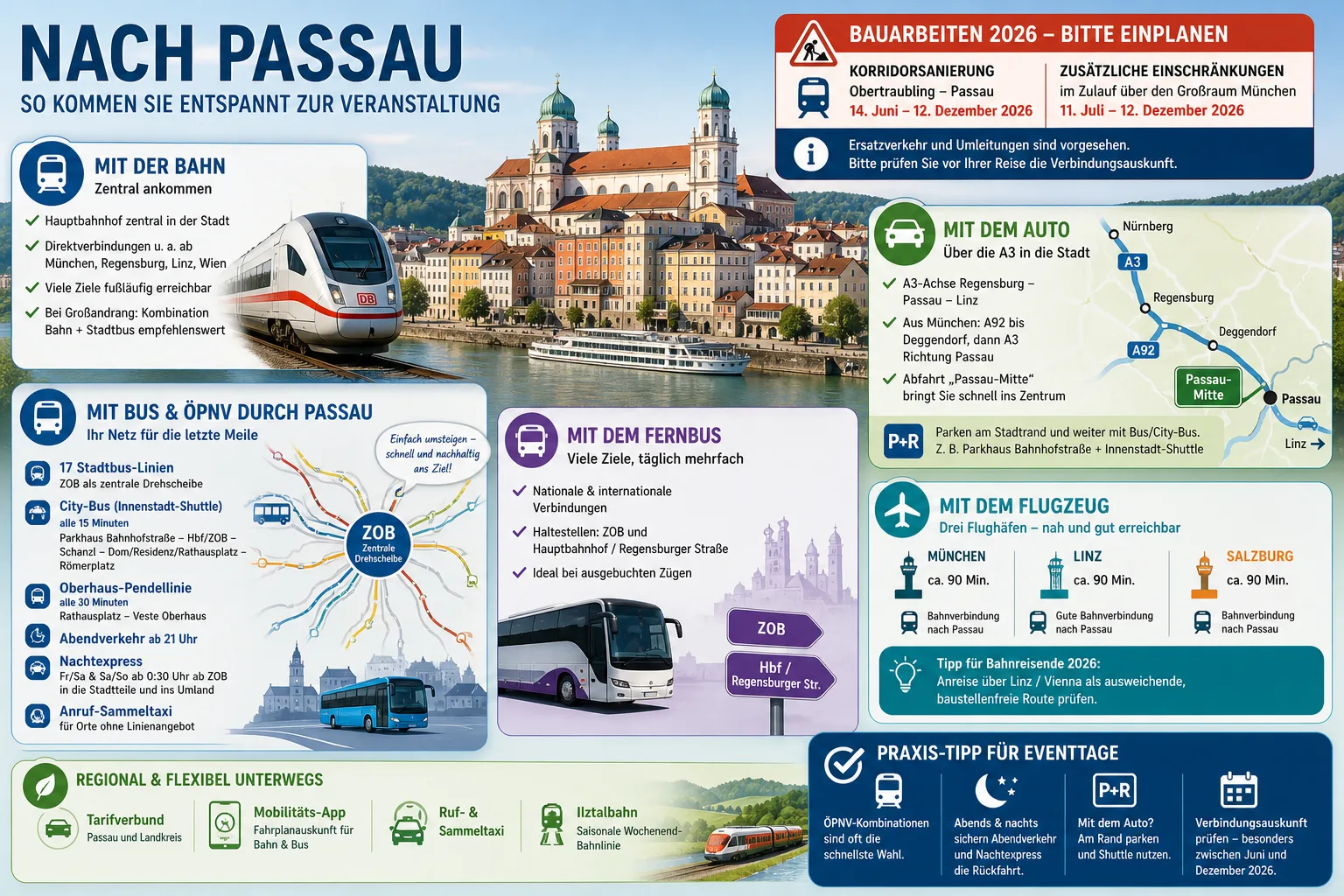
For many event guests, the train remains the most convenient option: Passau’s main station is close to the city, and from there, old town areas and central transfer points can be reached quickly – on foot or by city bus.
Construction and Timetable Situation 2026: What’s Important for Upcoming Event Days
One point is crucial for your 2026 planning: Between Obertraubling and Passau, restrictions are possible until December 12, 2026. Additionally, from July 11, 2026 to December 12, 2026, further construction work is announced on the approach via the greater Munich area. This may result in longer travel times, changed transfers, or temporary replacement services.
For events during this period, the most important rule is: Check your connection shortly before departure (ideally the day before and on the day of travel), because up-to-date construction sites, train cancellations, or replacement buses are shown in the travel information.
How to Make the Most of the Station & Connections
- Station as a mobility hub: Plan the main station as the starting point for distribution in the city (walking, city bus, taxi).
- Keep ZOB in mind: Many city bus lines converge at the ZOB near the station – this saves detours and simplifies transfers.
- Plan extra buffer: For major events, it’s worth allowing extra time for transfers, waiting times, and full vehicles.
If you arrive with luggage (e.g., for a festival weekend), the combination of train + city bus is usually more predictable than driving into the city center – especially if access to the old town is restricted.
Bus & City Bus Network: ZOB, City Bus, Evening and Night Services
In Passau, the city bus is often the backbone for the “last mile” on major event days – from the station, long-distance bus stop, or parking garage to the vicinity of the old town, Danube riverbank, and other event areas.
ZOB as a Hub
The Central Bus Station (ZOB) is located in the immediate vicinity of the main station. This is convenient for event guests: You can arrive at one place, orient yourself, and transfer to the right line in just a few steps.
To ensure this works smoothly, it’s worth clarifying before you travel:
- Which stop is closest to your event location?
- Which line goes there – and how often?
- What alternative do you have for the return journey if it gets crowded after the event?
City Bus & Seasonal/Event-Based Shuttle Ideas
For highly frequented areas in and around the old town, a dense city bus service is often the fastest way to reach the center without searching for parking. If you park near the station or arrive by train, the city transfer can make the difference: less walking, less stress, more predictability.
For particularly large events, cities and organizers typically also rely on temporary measures such as additional trips, extra buses, or shuttle notices. Whether and where such services apply is usually stated in current traffic reports and the local timetable information.
Evening and Night Services: Plan Your Return Realistically
For events that last into the late evening, the return journey is often the biggest stumbling block. Therefore, check in advance:
- whether an alternative timetable applies in the evening,
- whether a night service is available on weekends,
- whether a (call) shared taxi is an option.
This way you avoid having to rely on a spontaneous (and often expensive) solution after the event ends.
Long-Distance Bus as an Alternative When Trains Are Busy
If train connections are heavily booked on an event weekend or construction work leads to longer travel times, a long-distance bus can be a sensible alternative. Pay particular attention to:
- the exact stop (ZOB/area around the main station),
- the time buffer for traffic conditions on the highway,
- the connection to city bus/taxi for the last stretch.
Arriving by Car: A3, Entrances, Parking & Transfers
Passau is easily accessible from afar – especially via the A3. For many visitors, the car is convenient because it allows flexible departure times. On major event days, however, the problem is less the journey itself and more the city center logistics: traffic jams at entrances, short-term closures, and limited parking space.
Arrival via Highways: Arrive Predictably
Those coming from Regensburg/Nuremberg typically use the A3. From Munich, the combination via the A92/A3 is a common route. Check the traffic situation (jams, construction sites) before departure and, if possible, choose an arrival time well before admission begins.
Parking: Relieve the Center, Make Transfers Easier
In historic city centers, parking space is naturally limited. For event days, a strategy has proven effective that reduces search traffic:
- Arrive early and head for a parking garage or larger parking area.
- Transfer to city bus/shuttle or take a short walk for the last section.
- Plan the return journey with evening/night timetables in mind, so you don’t have to improvise “against the departure peak”.
If you have limited mobility or are traveling with children, switching to bus/shuttle is often more comfortable than long walks uphill or through dense crowds.
Why the Car Isn’t Always the Fastest Option
At major events, the car can lose time despite its flexibility – due to traffic jams, searching for parking, and longer walks. Those who instead use car + parking outside + city bus or simply train + city bus often reach the event area more predictably.
Airports & Smart Combinations
For guests traveling from further away, a combination of flight + train/long-distance bus can make sense. In practice: The crucial factor is not so much the airport itself as the reliable onward journey to Passau.
Especially during periods of extensive rail construction in 2026, it can be helpful to consider several options in advance:
- Primary route (best connection according to travel information),
- Backup route (alternative transfers or long-distance bus),
- earlier arrival on the event day to cushion delays.
Mobility Apps & Live Information
For final planning, use travel information with live data (train/public transport) and supplement this with traffic apps for car journeys. On event days, it’s not the “normal timetable” that counts, but the actual operation on the given date.
Practical Checklist for Your Event Day
- 48–24 hours before: Check connection(s), especially for trips during the restriction period until December 12, 2026.
- On the day of travel: Check live updates (delays, replacement services, traffic jams).
- Station/ZOB as a hub: Determine your destination stop in advance and consider the return journey (evening/night).
- Car fallback: If you come by car, plan parking so you don’t have to “push through” to the old town.
- Time buffer: Allow plenty of time for major events (admission, security checks, full vehicles).
- Safety: For late journeys home, choose a safe, reliable option (night service/shared taxi) rather than spontaneous routes.